

A clevis can screw onto the piston rod and still be the wrong connection. The fork has to admit the eye, the pin has to work in both legs, and the retainer needs the right groove. Here is a practical way to check the full stack before ordering.

The selection rule: specify the clevis as an assembly interface, not a single catalogue item. Confirm the rod thread, fork gap, pin bore, mating eye width, pin length and groove, retention method, loading and available swing. A standard reference narrows the geometry; it does not prove the whole joint is suitable.
The Dongzhou clevises, clips and pins range includes several connection styles. This page deals with a narrower question: how do the parts at one pinned rod-end connection actually fit together?
ISO 8140 is a mounting-dimension standard, not a complete part approval
ISO 8140:2018, as published by the Dutch standards body NEN, specifies mounting dimensions needed for the interchangeability of pneumatic-cylinder rod-end clevises. The scope includes its 1,000 kPa cylinder series, with cylinders made to ISO 6432 and ISO 15552 among the intended uses, while allowing other applications.
That scope matters. It does not tell a buyer that any two M12 clevises have the same thread pitch or that a particular pin-and-clip combination is approved. It also does not replace the current drawing and strength check for Dongzhou's offered material and exact size. NEN-ISO 15552:2018 covers the basic, mounting and accessory dimensions of a defined series of detachable-mounting pneumatic cylinders, again addressing interchangeability rather than every application load.
Our working position for a drawing review is to use the standard as a starting envelope. The purchase drawing must still close the interfaces that a standard title cannot: thread pitch and hand, eye thickness, the pin's working length, groove and retainer, finish and the permitted operating load.
The first trap: the thread fits on paper, but the pitch differs
The Dongzhou FK product table contains both regular and fine-pitch variants under the same nominal fork size. The examples below come directly from that table; they are not a universal ISO thread schedule.
| Dongzhou catalogue callout | Page-listed thread | What changes for purchasing |
|---|---|---|
| FK 8X16 | M8 × 1.25 | Do not substitute for the FG version based only on M8. |
| FK 8X16 FG | M8 × 1 | FG identifies the fine-pitch option on Dongzhou's page. |
| FK 12X24 | M12 × 1.75 | Check the actual cylinder rod's pitch. |
| FK 12X24 FG | M12 × 1.25 | The same nominal fork callout can lead to a different thread. |
The product page also defines LH as left-hand and FGLH as fine-pitch left-hand. Include the full suffix on the purchase order; do not assume the rod thread is right-hand.
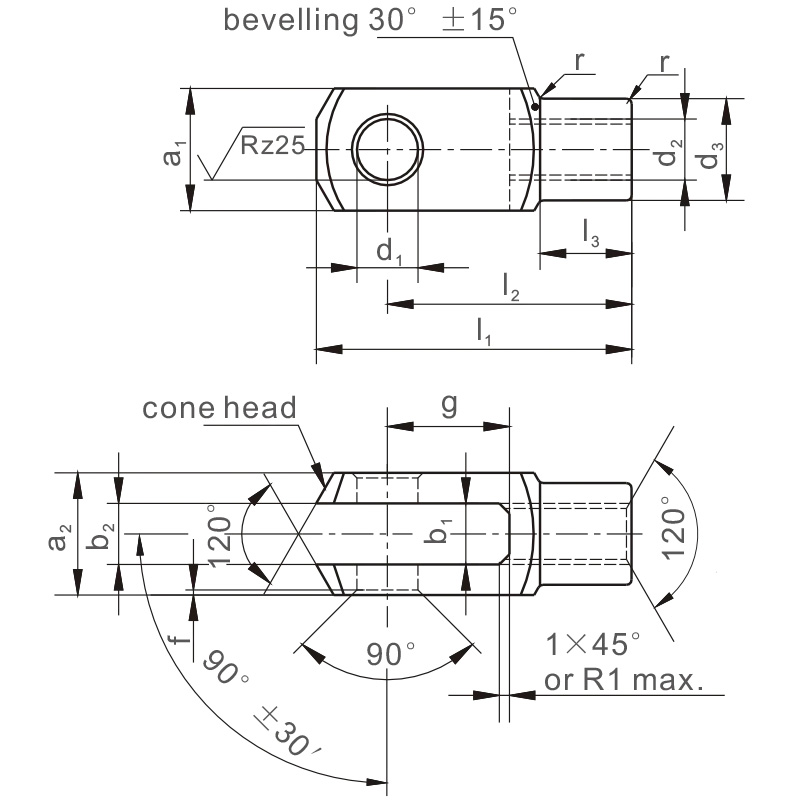

A second fork choice changes how it attaches to the rod. Dongzhou lists FT male-thread clevises separately from the FK internal-thread range. Specify the rod-end thread gender before comparing lengths or ordering a pin.
Then check the fork, eye and pin as a stack
Pin diameter alone cannot identify a suitable pin. The PF clevis pin page has fields for nominal pin diameter, length, reduced groove diameter and groove-related dimensions. That is the right level of detail for procurement. A pin can pass through both holes yet leave no usable groove outside the fork, or it can project too far into adjacent motion.

Read the pin from the outside inward
Start at the retainer groove and outer fork face, then check the first fork leg, eye, second fork leg and the opposite pin end. This direction of review makes a short pin or misplaced groove obvious before production.
For example, the PF6 row identifies a 6 mm nominal pin and a 17.0 mm listed length. That is still insufficient to approve a joint: the fork gap, eye width and groove position must be checked on the same drawing.
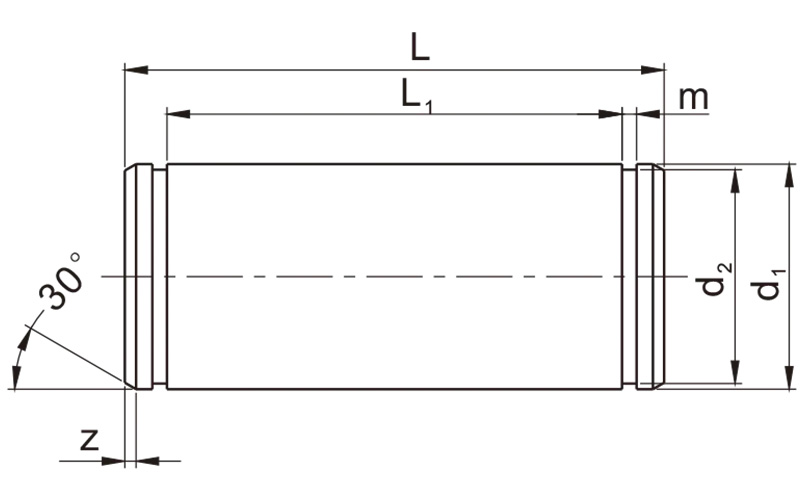
During a drawing review, we would inspect four interfaces: pin to fork hole, pin to eye bore, eye width to fork gap, and the retainer's location beyond the fork. The joint must rotate through its required plane without the eye rubbing a fork leg or a nearby bracket. We do not publish a universal side-clearance or pin-fit number because the correct value depends on the approved drawing, load and bearing arrangement.
The catalogue itself shows why retention needs a controlled drawing
Dongzhou offers several retention routes. The PM-K page describes hand-removable metric safety clips for FK joints and calls them an alternative to PM-S. The PM-S page says its clips are for FK and FT joints with PM clevis pins. The PM-E page says its DIN 471 circlip is used with PF clevis pins. The PM-F page describes a DIN 6799 retaining washer for a PM bolt.


The distinction matters because a retainer is part of the axial load path. A clip can appear to fit a shaft while the groove diameter, width or distance from the fork is wrong. If the chosen route is a folding spring pin rather than a separate PF pin and clip, Dongzhou's CL series page lists explicit FK mates such as CL 6X12 for FK 6X12. That is a different assembly choice and should be called out as such.
What a drawing-ready clevis order looks like
Dongzhou's site shows assembled alternatives, including an FK/FT clevis, bolt and PM-K clip joint with example code FK6×12-ASSY/03, and a clevis with folding spring pin example FK6×12-ASSY/01. These examples confirm that the retained joint can be ordered as an assembly. They do not prove that a loose clip from another route is interchangeable.

One code is useful; one drawing is better
The assembly code reduces ambiguity only when the revision-controlled drawing states exactly which fork, pin or bolt, clip and finish are supplied. For a replacement or custom version, request the same detail instead of relying on a photo.
- Identify the rod. Give the cylinder model if available, but also write the full male or female thread designation, pitch, hand and usable engagement.
- Define the fork and eye. State FK or FT family, fork gap, hole size, mating eye bore and width, and the plane and range of rotation.
- Define the pin. Specify diameter, working length, head or end form, groove position and material. Include push and pull forces and any end-stop shock in the application note.
- Close the retention choice. Use the approved clip or circlip designation from the current controlled drawing, especially where the public pages disagree.
- Set inspection points. Identify dimensions that must be checked on the delivered assembly, plus free rotation and positive axial retention after installation.
Our practical recommendation is to send the assembly section with the RFQ, even when asking for a standard part. Dongzhou states that it can make non-standard parts from drawings or samples, but a sample cannot reveal intended tolerances, thread class, material condition or allowable load by itself. Those details belong on the approved drawing.
Send the connection drawing, not a loose part number
Mark the cylinder rod thread, FK or FT fork, mating eye, pin stack and the retention detail you want reviewed. Dongzhou can compare it with the current catalogue family or discuss a non-standard drawing. If PF retention is involved, ask for the approved pin-and-clip drawing first.
Request a joint drawing reviewNingbo Dongzhou Transmission Co., Ltd. | sale02@hkdongzhou.com | +86-574-87815807
Questions buyers ask before ordering
Does ISO 8140 make any rod clevis interchangeable?
No. ISO 8140:2018 specifies mounting dimensions for interchangeability within its scope. It does not make every thread pitch, material, pin, retainer, load rating or special design interchangeable. Check the exact clevis and mating assembly drawing.
Can a correct pin diameter still give the wrong clevis joint?
Yes. Pin length, fork gap, eye width, shoulder clearance, groove location and retainer type can still be wrong. Specify these interfaces together and inspect free rotation and axial retention after assembly.
Which retainer fits a Dongzhou PF clevis pin?
The current Dongzhou pages need clarification. The PF page mentions a DIN 6799 safety clip, while the PM-E DIN 471 page says PM-E is used with PF pins. Do not select either by the page wording alone. Ask Dongzhou for the current controlled PF pin drawing, groove dimensions and approved retainer part number.
What should I send to quote a complete rod clevis joint?
Send the cylinder rod thread with pitch and hand, the FK or FT fork callout, mating eye width and bore, pin and groove details, chosen retainer or assembly code, operating force in both directions, movement plane, material and finish, quantity and the latest assembly drawing.
Source notes
Company products, variants, images and assembly codes come from the linked Dongzhou product pages. The standards' scopes are described by national standards body NEN on its ISO 8140:2018 and ISO 15552:2018 adoption pages. Neither is used as a certificate for a Dongzhou product. No unsupported load rating or clip compatibility is supplied.