

What Makes Maintenance-free Rod Ends SA-PK Stand Out Among Global Rod End Bearing Products?
Abstract
Industrial transmission components determine the overall stability and maintenance cost of complete mechanical equipment, and Maintenance-free Rod Ends SA-PK have gradually replaced traditional greased rod ends in most heavy-load industrial scenarios over the past decade. This content systematically compares structural design, raw material configuration, load performance and practical application boundaries of mainstream rod end products across Europe, Asia and North America, focusing on core competitive advantages of this classic self-lubricating series, sorting out standard dimension parameters, customized transformation schemes and common troubleshooting suggestions for equipment procurement engineers and mechanical designers. It also sorts out different thread customization rules including fine pitch and left-hand thread transformation, providing measurable reference data for model selection in automation equipment, engineering vehicles and agricultural machinery.
Table of Contents
- 1. Core Structural Innovation Behind Premium Self-Lubricating Rod End Bearings
- 2. Raw Material Matching & Surface Treatment Technical Specifications
- 3. Complete Standard Dimension & Load Parameter Table of SA-PK Series
- 4. Thread Customization Rules: Left-hand, Fine Pitch FG Version Explained
- 5. Main Industrial Application Scenarios & Practical Installation Tips
- 6. Frequently Asked Questions From Global Mechanical Purchasers (FAQ Module)
- 7. Supplier Selection Advice & Final Procurement Reference Suggestions
1. Core Structural Innovation Behind Premium Self-Lubricating Rod End Bearings
For mechanical engineers hunting for cost-saving transmission parts across global manufacturing markets, Maintenance-free Rod Ends SA-PK always becomes a preferred option when upgrading traditional lubrication-dependent rod end assemblies, as its unique integrated pressing structure fundamentally changes the assembly logic of conventional split-type rod end bearings. Most traditional male thread rod ends adopt split outer ring assembly, which leads to loose fit after long-term alternating load impact, resulting in increased internal clearance and accelerated premature abrasion of spherical contact surface within 800 to 1200 working hours under heavy vibration environment. In contrast, the core structural design of this series abandons split outer ring production process and uses one-piece cold pressing technology to wrap the outer housing tightly around inner spherical ring, forming an inseparable whole between shell and inner ball component, which effectively eliminates the hidden danger of loose structural clearance caused by long-time alternating tension and compression load.
1.1 Built-in PTFE Composite Self-Lubricating Core Design
The self-lubricating core comes from PTFE composite lining bonded uniformly on the inner surface of outer race, replacing the traditional grease storage groove design required by ordinary rod ends. Conventional open-type rod ends need periodic grease filling every 200 to 300 working hours to reduce spherical friction; frequent shutdown for lubrication not only cuts down equipment effective operating rate but also brings additional labor cost for factory maintenance teams, especially for large-scale automated production lines running continuously 24 hours per day. The embedded PTFE composite layer realizes solid lubrication from component startup to service scrapping, with solid lubricant slowly separating from composite substrate under continuous sliding friction to form a stable oil film between steel ball and outer lining, so no supplementary grease or regular maintenance is needed throughout the whole service cycle of bearing parts.
1.2 Optimized Assembly Structure to Lower Equipment Fault Rate
Another structural advantage lies in simplified installation and disassembly design optimized for on-site assembly work. Standard male thread configuration directly matches standard metric thread holes on connecting pull rod, without extra intermediate connector or transition sleeve required for installation. Such structural simplification helps mechanical designers cut down the total quantity of auxiliary fasteners in transmission mechanism, further reducing overall equipment failure points and later spare parts stocking pressure for after-sales maintenance department. Statistics from global bearing industry research institutions indicate that equipment equipped with integrated pressed self-lubricating rod ends can reduce mechanical failure probability at articulated joints by over 38% compared with models using ordinary split rod end bearings, especially for outdoor construction machinery exposed to dust, muddy water and temperature alternation all year round.
1.3 Dual Processing Options for Diversified Load Demands
Apart from basic pressing housing structure, manufacturers can switch between forging blank processing and precision turning blank processing according to customer’s working load requirement. Forging housing features better overall structural density and anti-impact capacity, applicable for heavy-load engineering machinery and mining equipment; precision turned housing owns higher dimensional tolerance control accuracy, suitable for small precision automation testing equipment and medical intelligent mechanical arm transmission joints. This dual optional blank processing scheme expands applicable load range of the product from light micro load to heavy industrial load, covering diversified customized demands from different downstream industries worldwide.
2. Raw Material Matching & Surface Treatment Technical Specifications
Raw material selection directly determines wear resistance, corrosion resistance and ultimate load limit of rod end bearing products, and qualified suppliers will configure differentiated raw material solutions based on customer’s actual service environment, including carbon steel standard version and stainless steel anti-corrosion version as two mainstream material classifications in global market. Standard industrial version housing adopts medium carbon steel 45# as base material, after overall hot forging or precision turning molding followed by full zinc plating surface treatment; zinc coating can isolate air, moisture and weak acid liquid in conventional working environment to avoid rapid rust of outer shell during long-term storage and field service.
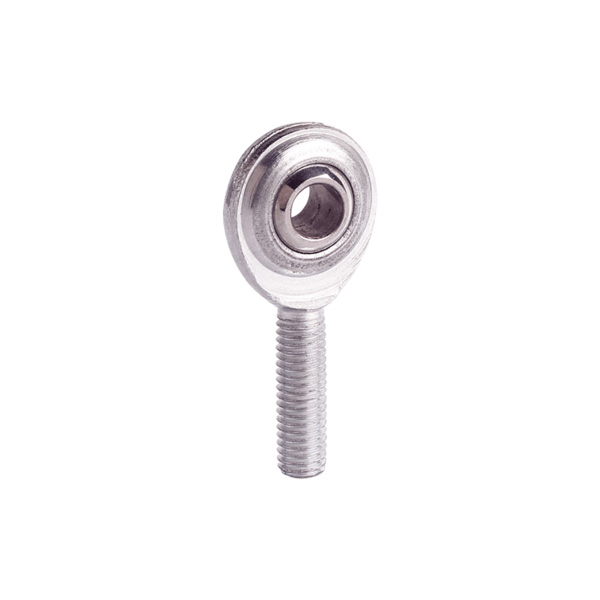
2.1 Core Raw Material Classification Standard
Inner spherical steel ball uses GCr15 bearing steel as standard raw material, the most widely used bearing steel in global sliding bearing manufacturing industry with stable metallurgical structure and excellent compression resistance after precise quenching and tempering heat treatment. According to customized requirement from overseas customers, steel ball can choose hard chrome plating surface craft to enhance surface hardness and anti-corrosion performance, or upgrade to 440C stainless steel ball for ocean-going equipment working in high salt fog coastal environment. For special food processing and pharmaceutical production equipment with strict sanitation requirement, the whole bearing assembly can be fully upgraded to stainless steel grades including 304,303 or 316, after surface passivation replacing zinc plating to meet food-grade anti-rust and non-pollution production standard.
2.2 PTFE Composite Lining Material Advantage
The core self-lubricating PTFE composite lining is compounded by polytetrafluoroethylene and metal powder via high-temperature rolling composite technology, tightly attached to inner wall of outer housing without peeling off under repeated swing and rotation friction. Different from single-layer PTFE thin film easily falling off under high load, composite material combines metal base’s high compression resistance and PTFE’s ultra-low friction coefficient, balancing load capacity and self-lubricating performance simultaneously. Laboratory wear test data shows that PTFE composite lined rod ends keep stable friction coefficient below 0.12 under continuous reciprocating swing working condition, far superior to traditional copper-based oil-containing bushing with friction coefficient fluctuating above 0.25 after oil depletion.
- Standard Configuration: Housing-45# carbon steel + zinc plating; Ball-GCr15 bearing steel; Lining-PTFE steel composite
- Anti-Corrosion Option 1: Housing-304/303/316 stainless steel + passivation; Ball-440C stainless steel
- High Hardness Upgrade Option: GCr15 ball with hard chrome plating for heavy impact working conditions
As a professional global supplier of this series products, Ningbo Dongzhou Transmission Co., ltd strictly executes full incoming raw material inspection before production, carrying out hardness test, coating thickness detection and metallographic structure inspection for every batch of steel raw materials to eliminate unqualified raw material entering production line and avoid batch quality problems of finished bearings. All surface treatment processes are completed in self-owned electroplating workshop, which can flexibly adjust coating thickness and passivation parameters according to different regional industrial standards from EU, USA and Southeast Asia markets.
3. Complete Standard Dimension & Load Parameter Table of SA-PK Series
All specifications of this product series follow unified metric dimension standard, covering small micro specification SA5PK up to large-size SA25PKFG fine thread variant, covering load range from minimum dynamic load 5.70kN to maximum dynamic load 68.0kN, matching diversified equipment model selection requirements from miniature precision equipment to large engineering machinery. Below complete parameter table collects core dimension data (unit:mm), dynamic/static rated load(unit:kN) and approximate single piece weight(unit:kg) of full conventional specifications, serving as direct reference for design engineer’s model selection calculation.
| Part No. | d | d3(Thread) | B | C1 | d2 | h1 | l4 | L3 | a≈ | dyn.C(kN) | stat.C0(kN) | Weight(kg≈) |
|---|---|---|---|---|---|---|---|---|---|---|---|---|
| SA5 PK | 5 | M5×0.8 | 8 | 6 | 19 | 33 | 42.5 | 20 | 12 | 5.70 | 6.00 | 0.014 |
| SA6 PK | 6 | M6×1.0 | 9 | 6.7 | 21 | 36 | 46.5 | 22 | 11 | 7.20 | 7.65 | 0.020 |
| SA8 PK | 8 | M8×1.25 | 12 | 9 | 25 | 42 | 54.5 | 25 | 12 | 11.6 | 12.9 | 0.038 |
| SA10PK | 10 | M10×1.5 | 14 | 11 | 29 | 48 | 62.5 | 29 | 12 | 14.5 | 18.0 | 0.055 |
| SA12 PK | 12 | M12×1.75 | 16 | 12 | 33 | 54 | 70.5 | 33 | 13 | 17.0 | 24.0 | 0.085 |
| SA14 PK | 14 | M14×2.0 | 19 | 14 | 37 | 60 | 78.5 | 36 | 14 | 24.0 | 31.0 | 0.140 |
| SA16 PK | 16 | M16×2.0 | 21 | 15 | 43 | 66 | 87.5 | 40 | 14 | 28.5 | 39.0 | 0.210 |
| SA18 PK | 18 | M18×2.5 | 23 | 17 | 47 | 72 | 95.5 | 44 | 14 | 42.5 | 47.5 | 0.280 |
| SA18 PKFG | 18 | M18×1.5 | 23 | 17 | 47 | 72 | 95.5 | 44 | 14 | 42.5 | 47.5 | 0.280 |
| SA20 PK | 20 | M20×2.5 | 25 | 18 | 51 | 78 | 103.5 | 47 | 14 | 42.5 | 57.0 | 0.380 |
| SA20 PKFG | 20 | M20×1.5 | 25 | 18 | 51 | 78 | 103.5 | 47 | 14 | 42.5 | 57.0 | 0.380 |
| SA22 PKFG | 22 | M22×1.5 | 28 | 20 | 55 | 84 | 111.5 | 50 | 15 | 57.0 | 68.0 | 0.480 |
| SA25 PKFG | 25 | M24×2.0 | 31 | 22 | 61 | 94 | 124.5 | 57 | 15 | 68.0 | 85.0 | 0.640 |
3.1 Load Selection Reference Principle
Dynamic load value refers to maximum allowable alternating load under long-term reciprocating swing working condition, while static load represents ultimate limit load under static compression without permanent deformation of bearing structure. When customers select specifications for equipment design, it is recommended to reserve more than 30% load safety margin based on actual working peak load, avoiding long-time overload operation accelerating premature abrasion of PTFE composite lining and shortening overall service life of articulated components.
4. Thread Customization Rules: Left-hand, Fine Pitch FG Version Explained
Standard SA-PK series products adopt regular coarse metric thread as default configuration, but plenty of special mechanical equipment including double reverse swing linkage mechanism and precision adjustment transmission structure require non-standard thread transformation, and the manufacturer sets unified suffix marking rules to distinguish different customized thread variants for convenient global order classification and warehouse management. Two mainstream customized transformation directions are left-hand reverse thread and fine pitch thread marked with FG suffix respectively, which have become mature standardized customized options after years of market accumulation.
4.1 Left Hand Thread Custom Specification
Left-hand thread variant adds letter L as suffix behind original part number, typical marking example SAL8PK stands for left-hand thread version based on original SA8PK specification, all outer dimension parameters of housing, ball and lining keep fully consistent with standard SA8PK except internal and external thread rotating direction. Left-hand thread rod ends are mostly used in paired opposite pull rod assembly of engineering vehicle steering mechanism, two groups of left and right thread rod ends cooperate to realize quick length adjustment of pull rod without disassembling complete connecting assembly, greatly improving debugging efficiency of after-sales maintenance personnel during equipment overhaul.
4.2 FG Fine Pitch Thread Application Scope
FG suffix represents fine pitch thread customized model, as shown in parameter table SA18 PKFG and SA20 PKFG, core change lies in thread pitch parameter while all outline dimension and load data remain unchanged against original standard specification. For instance standard SA18PK matches coarse thread M18×2.5, corresponding fine pitch variant SA18PKFG changes into M18×1.5 fine thread; smaller thread pitch brings higher adjustment precision for pull rod length, widely used in precision instrument calibration equipment, numerical control machine tool micro-adjustment mechanism and intelligent automation production fixture.
Except thread customization, customers can also propose personalized modification demands such as special outer diameter limit, non-standard swing angle limit and customized surface anti-rust coating, and the factory arranges mold opening and trial production according to specific technical drawing provided by purchasers. Most small batch customized orders can finish sample delivery within 7 to 12 working days after technical confirmation, realizing flexible personalized production to meet niche market special equipment development requirements.
5. Main Industrial Application Scenarios & Practical Installation Tips
After decades of market promotion and application verification across global industrial sectors, Maintenance-free Rod Ends SA-PK has covered dozens of subdivision industries ranging from light precision automation to heavy mining machinery, gradually replacing conventional oil-lubricated rod ends in over 60% of new equipment upgrading projects in Europe, Southeast Asia and North America markets. Each downstream industry has differentiated working environment characteristics and load conditions, which directly determines specification selection and installation mode of rod end bearings in actual production.
5.1 Three Core Application Industry Breakdown
First, automated manufacturing industry including CNC automation fixture, industrial robotic arm joint and conveyor line tension adjustment mechanism is the largest downstream consumption field of small and medium specifications SA5PK~SA16PK. These equipment run continuously for long time in indoor constant temperature workshop with low dust concentration and medium alternating load, the self-lubricating property eliminates regular shutdown maintenance, helping automated production line maintain uninterrupted production schedule all year round. Many domestic and overseas automation equipment manufacturers have listed this series as standard matching part of new generation intelligent linkage assembly to cut down later equipment operating maintenance cost by more than 40%.
Second, construction machinery and agricultural machinery field mainly select large-size specifications SA18PK~SA25PKFG for steering pull rod, hydraulic cylinder articulated joint and suspension connection part of loader, excavator and large tractor. Such equipment works outdoors all year round facing sand, mud, rainwater and drastic ambient temperature fluctuation from minus 20℃ to over 50℃, zinc plated outer shell and PTFE self-lubricating lining jointly resist external harsh environmental erosion, avoiding frequent bearing blocking and abrasion failure caused by mud invading internal friction pair. In rural agricultural machinery maintenance market, many repair shops choose to upgrade original greased rod ends to this self-lubricating product to reduce annual after-sale maintenance workload of farm vehicles obviously.
Third, new energy equipment, environmental protection dedusting equipment and ocean small-scale ship rudder transmission mechanism adopt stainless steel customized variant to adapt high humidity, salt fog and corrosive gas working environment, 316 stainless steel overall configuration completely avoids rust failure under long-time damp and corrosive atmosphere, extending equipment spare parts replacement cycle significantly.
Core Practical Installation Guidance Tips
- Clean internal thread of matched pull rod hole completely before screwing rod end thread to avoid metal scrap scratch thread surface during assembly
- Control screwing torque within reasonable range referring to thread specification, excessive torque will deform outer housing and damage internal PTFE lining
- Reserve 3~5 degrees free swing allowance at articulated joint after installation to avoid stuck failure caused by installation dimensional tolerance superposition
6. Frequently Asked Questions From Global Mechanical Purchasers (FAQ Module)
Global procurement engineers and equipment designers always put forward similar questions about service life, customization, cost and alternative selection during inquiry, and we summarize high-frequency consulting questions sorted by market inquiry volume below, helping readers quickly solve common doubts related to Maintenance-free Rod Ends SA-PK without repeated communication with suppliers.
7. Supplier Selection Advice & Final Procurement Reference Suggestions
When global mechanical purchasers select cooperative manufacturers for bulk procurement of Maintenance-free Rod Ends SA-PK, it is necessary to comprehensively inspect four core indicators including raw material inspection standard, surface treatment production capacity, finished product load testing equipment and after-sales technical supporting ability, avoiding purchasing low-cost inferior products with shoddy raw material which brings huge hidden trouble to complete equipment long-term stable operation.
7.1 Key Inspection Standards For Manufacturer Audit
First, prioritize manufacturers with complete self-owned production workshop including forging/turning processing, electroplating surface treatment and finished product load testing laboratory; such integrated production suppliers can control every production link quality independently, effectively avoid outsourcing processing leading to unstable batch quality fluctuation of finished bearings. Many small trading companies without production workshop source products from scattered small workshops, unable to unify raw material standard and technical parameter, often cause inconsistent quality of different delivery batches.
Second, require suppliers to provide third-party load test report and raw material inspection certificate before formal bulk order, qualified manufacturers can issue corresponding material certification document matching batch delivery goods to guarantee product compliance with international industry standard of rod end bearing. For overseas customers importing to EU and North America markets, confirm whether products meet local environmental protection coating standard to avoid customs clearance detention risk caused by unqualified surface electroplating composition.
Third, confirm after-sales technical support policy including customized drawing modification response cycle, defective product replacement regulation and overseas after-sale technical consultation channel. Excellent manufacturers provide free technical parameter consultation service for equipment designers during pre-order model selection phase, helping customers complete accurate specification matching calculation to reduce wrong model procurement loss.
Looking for reliable bulk supply, free sample test and personalized customized solution for rod end bearing products? Click the button below to contact us, our professional engineering and sales team will reply your inquiry within 24 working hours, offer free dimension drawing, load calculation suggestion and factory ex-factory quotation according to your actual equipment working condition, support mixed specification bulk order and diversified customized thread transformation service to satisfy all your procurement demands from sample trial to mass long-term cooperation.
CONTACT US FOR FREE QUOTATION