

Clevises with Rotating Shaft: Why This "Small Part" Solves Big Problems
In mechanical design, some seemingly insignificant components can either save you a lot of trouble or create endless headaches if chosen poorly. Clevises with Rotating Shaft fall into the former category. They are commonly found in cylinder rod ends, wire rope terminals, steering linkages, and countless other places where load transmission and articulation are required.
At first glance, many mistake it for a standard clevis. But the phrase "with Rotating Shaft" is precisely what sets it apart — and what makes it a genuine problem-solver in real-world applications.
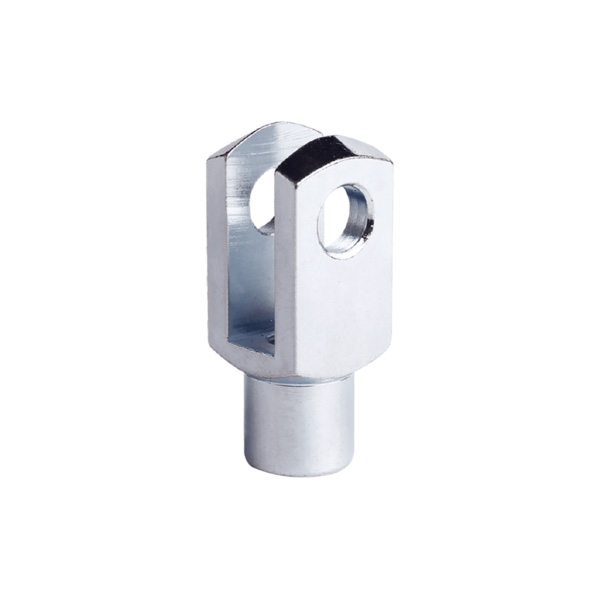
What Problem Does It Actually Solve?
A standard fixed-shaft clevis requires perfect alignment between the two fork ears and the mating component. If they are not exactly coaxial, the pin either won't go through, or it will bind during operation, creating friction and stress. In harsh field conditions, minor installation deviations are almost inevitable. The traditional approach is to hammer the pin in or add shims to force alignment — but this introduces additional internal stresses and accelerates premature wear.
Clevises with Rotating Shaft address this issue at the design level. The shaft is not locked in a fixed position; it is designed to rotate independently within the fork. This simple change delivers two tangible benefits:
First, easier installation. When using this type of clevis, you no longer need to precisely adjust the radial position of the connected component. The rotating shaft will automatically accommodate minor angular misalignments. In tight assembly spaces or during rapid replacement scenarios, this convenience is especially valuable.
Second, compensation for motion deviations. During machine operation, shafts or levers may experience slight coaxial deviations due to load-induced deflection, manufacturing tolerances, or thermal expansion. A rigid connection translates these deviations into internal stresses that fatigue the components over time. Clevises with Rotating Shaft, however, absorb and compensate for these axial and radial movements through the shaft's independent rotation, allowing the entire linkage to operate more smoothly with reduced wear.
What to Look for When Selecting One?
When choosing a clevis with a rotating shaft, the two most critical factors are material and dimensions.
Material directly determines service life — especially in harsh environments. The most common option is zinc-plated steel, which offers a good balance of cost and performance for indoor or mildly humid conditions. But if your application is outdoors, near coastlines, or exposed to chemical agents, you need to think more carefully.
According to industry corrosion-resistance guidelines, in salt-spray environments, ordinary zinc-plated carbon steel may show significant rust within six months. In contrast, 316 stainless steel offers several times the salt-spray resistance. While the upfront cost is higher, it eliminates frequent replacements and unplanned downtime. For extremely aggressive environments — such as those involving acidic media — you may even need to consider duplex stainless steel or specialty alloys.
Dimensions are equally important. Most products in this category follow the DIN 71752 standard, with key parameters including thread size (e.g., M5, M6, M10, M12), fork width, and shaft diameter. When selecting, you should match the thread size to your connecting rod and verify the static load capacity. For example, an M6-rated clevis typically offers a static load capacity of approximately 2,400 N, while an M10 version can handle up to around 6,000 N.
Installation and Maintenance Tips
When you receive the product, it usually comes in one of two configurations:
-
Fork body only (with the rotating shaft pre-installed) — you will need to purchase a separate pin (commonly referred to as KL or SL type).
-
Complete assembly — including the pin and a locking circlip/retaining ring. The SL-type pin typically features a snap ring for tool-free quick release, which is especially convenient during maintenance.
After installation, do not overlook the most critical step: lubrication. Manufacturers universally recommend applying grease to all moving parts and contact surfaces during assembly. For stainless-steel rotating assemblies, regular application of lithium-based grease with high-pressure additives is essential. This prevents galling and seizing under heavy loads — a failure mode that can lock up the joint entirely.
Clevises with Rotating Shaft are a mature, well-optimized product designed to solve real-world installation and motion-compensation challenges. The next time you are working on a linkage system, dealing with confined spaces, or facing misalignment concerns that would be costly to machine away, consider this component. Choosing the right material and size will make your equipment more reliable, reduce maintenance frequency, and ultimately lower your total cost of ownership.