

The choice is really between two sliding systems. A PTFE-lined bearing brings its own solid lubricant. A steel-to-steel bearing depends on fresh grease reaching the loaded contact. Load, movement and the machine's ability to maintain that grease path decide which system makes sense.
Choose a maintenance-free PTFE-lined spherical plain bearing when routine relubrication is impractical and the liner's load, sliding-speed, temperature and environmental limits suit the duty. Choose a maintenance-required steel-to-steel bearing when severe static, alternating or shock load favors that sliding pair and the machine can reliably deliver the specified lubricant to the contact. Maintenance-free still requires inspection, and a sealed steel-to-steel bearing can still require grease.
“Which one is stronger?” is usually the wrong first question. At Dongzhou, the more useful question for a drawing review is: can this machine keep the chosen sliding surface in a healthy lubrication condition for its full duty cycle?
For one design, that means protecting a self-lubricating liner from damage and unsuitable lubricant. For the other, it means designing an actual grease route, choosing a lubricant for the conditions and making sure maintenance will happen after the machine leaves the factory. The bearing bore alone tells us none of this.
1. Maintenance-free describes the sliding contact, not the whole joint
Maintenance-free
A self-lubricating layer, often a PTFE composite or PTFE fabric, sits between the steel surfaces. Routine relubrication is not part of the intended operation for the relevant design. Wear, inspection, sealing and correct installation still matter.
Maintenance-required
The sliding pair, commonly steel-to-steel, needs grease before operation and at intervals during service. Grooves, holes and the housing or shaft passage must work as one lubrication route.
The SKF spherical plain bearing catalogue makes a useful distinction: maintenance-free is an industry term for a self-lubricating sliding contact, but it does not remove the bearing from scheduled inspection. This wording prevents a common purchasing mistake. “No grease fitting” is a construction detail; “no maintenance of any kind” is an unsupported promise.
2. PTFE-lined vs steel-to-steel: a decision table
| Decision factor | PTFE-lined maintenance-free | Steel-to-steel maintenance-required | What must be confirmed |
|---|---|---|---|
| Lubrication principle | Solid-lubricating liner and transfer film for the applicable design | Grease film replenished through bearing and machine passages | Exact sliding material and manufacturer's lubrication instruction |
| Service access | No routine relubrication point is needed | Technician, automatic system or central line must reach the bearing | Access after guards and attachments are installed |
| Load behavior | Must stay within liner-specific pressure and sliding-velocity limits | Often considered for heavy static, alternating or shock loads when lubrication works | Normal and peak load, direction, reversal and motion while loaded |
| Small oscillation | Review liner wear and whether the motion distributes contact | Constant-direction load can make lubricant supply to the loaded zone difficult | Angle, frequency, dwell, load direction and relubrication effectiveness |
| Friction and wear | Friction changes through running-in; clearance grows as the liner wears | Friction and wear depend strongly on lubricant presence and condition | Allowable torque, play and end-of-life criterion |
| Contamination | Liner and seals must be protected from abrasive particles and unsuitable fluids | Fresh grease may help purge some contaminants, but ingress can still damage the contact | Dust, water, washdown, chemicals, seal design and purge path |
| Cost driver | Bearing construction, replacement access and liner life | Bearing plus grease, delivery hardware, labor, downtime and missed-service risk | Total service plan rather than purchase price alone |
This table gives selection directions. It is not a cross-brand load or life comparison. Use the exact manufacturer's calculation and current product data.
3. A PTFE liner is a working surface, not a grease reservoir
In a steel-to-PTFE fabric or steel-to-PTFE sintered-bronze bearing, tiny amounts of PTFE transfer from the liner to the hard counterface during running-in. The transferred material helps form the sliding condition that the bearing was designed to use.
This explains a counterintuitive service rule. Adding oil or grease is not automatically “extra protection.” SKF states that external lubricant on those sliding surfaces can disturb self-lubrication and shorten bearing life. Schaeffler's Plain Bearings technical catalogue likewise warns that its maintenance-free designs must not be lubricated because lubrication after dry running-in impairs the smoothing process.
Wear does not disappear. As the liner wears, internal clearance can increase. The service limit therefore needs a measurable criterion such as allowable radial play, joint movement, noise or positioning error. “Run until failure” is a poor specification for a joint whose growing clearance affects a cylinder, linkage or sensor position.
4. With steel-to-steel, the grease path belongs on the drawing
Steel-to-steel spherical plain bearings need relubrication to reduce friction and wear and to protect against corrosion and contamination. The SKF catalogue calls for a housing or shaft duct that supplies fresh grease directly to the bearing. The ring groove and holes only distribute lubricant that reaches them.
Our factory-side view is straightforward: a grease nipple on the outside of a housing is not proof that the bearing is lubricated. During drawing review, trace the complete path. Check that the drilled passage intersects the annular groove after installation, that a shoulder does not block an oil hole, that grease has somewhere to displace, and that the fitting remains accessible in the assembled machine.
Relubrication intervals cannot be copied safely from another machine. Load magnitude, load direction, oscillation angle, frequency, temperature, contamination and lubricant condition all matter. Very small alignment movement under heavy, constant-direction load deserves special attention because the loaded zone may not receive fresh grease effectively.
The bearing also needs grease before first operation. A phosphated surface or factory-applied running-in treatment does not replace the lubrication plan specified for the series.
5. Motion and load decide which weakness matters more
A loaded bearing that oscillates or tilts is a dynamic wear case even when its movement is slow. SKF's load guidance distinguishes sliding movement under load from a truly static condition. This is why a “maximum static load” alone cannot select either sliding system.
There is no honest rule that says steel-to-steel always carries more load or PTFE always lasts longer. Catalog load ratings come from product-specific methods, and operating life depends on motion as well as force. Compare permissible operating range and calculated life for the two exact candidates.
If the machine needs complete shaft revolutions rather than an articulating joint, pause this comparison. The spherical plain bearing vs ball bearing guide explains why continuous rotation may call for a rolling-bearing family instead.
6. A seal does not decide the maintenance category
Sealing and lubrication are separate decisions. A seal can retain lubricant and slow contamination ingress, but it does not tell you whether the sliding pair is self-lubricating or grease-dependent.
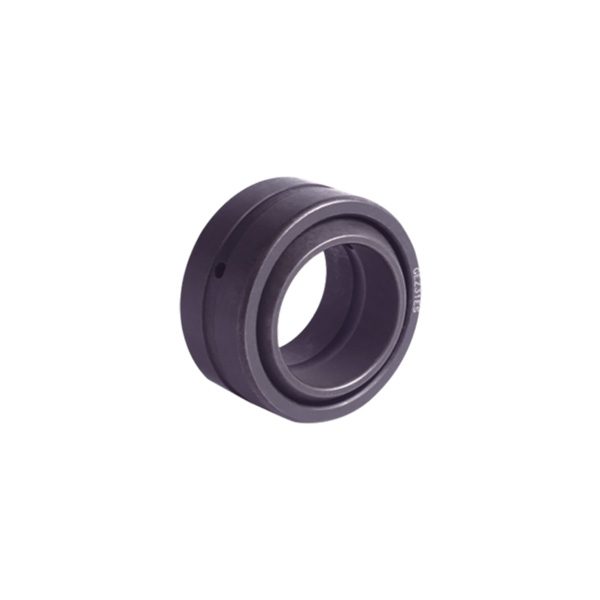
Dongzhou's current GE ES-2RS product page is a clear example. It lists steel-to-steel sliding contact, lubrication grooves and holes, plus seals on both sides for the 2RS version. We would not call that series maintenance-free simply because it is sealed.
Seals also have limits. Their material must suit temperature, water, chemicals and sliding speed, and the mating surface must not cut the lip. A grease-purged steel-to-steel joint needs an exit route for displaced grease. A PTFE-lined bearing needs protection that does not introduce an incompatible lubricant into the liner.
7. Mapping the current Dongzhou range
The following details come from Dongzhou's live product pages. We have kept the comparison at construction level because the load-rating figures on those pages do not display a unit label. Final dimensions, ratings and availability should be reconfirmed at quotation.
| Dongzhou family | Current page-listed construction | Maintenance route | Factory review point |
|---|---|---|---|
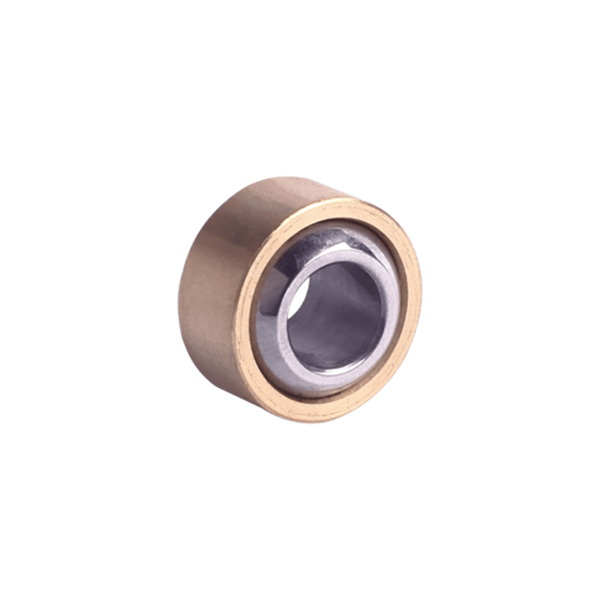
| GE UK | Two-piece metric range; thin PTFE fabric; steel-to-PTFE composite; pressed outer ring; chromium-plated inner spherical surface | Maintenance-free | Protect the liner during pressing and verify load, angle, clearance and environment |
| G PW | PTFE-lined family with page-listed brass H62, carbon-steel or stainless outer options and GCr15 or 440C inner options by designation | Maintenance-free | Specify the exact material combination instead of writing only G PW |
| COM..T / HCOM...T | Two-piece PTFE-lined construction; carbon-steel outer ring and hard-chromium-plated GCr15 inner ring listed in the product details | Maintenance-free | Confirm the current drawing because the live page's size-system wording is inconsistent with its table |
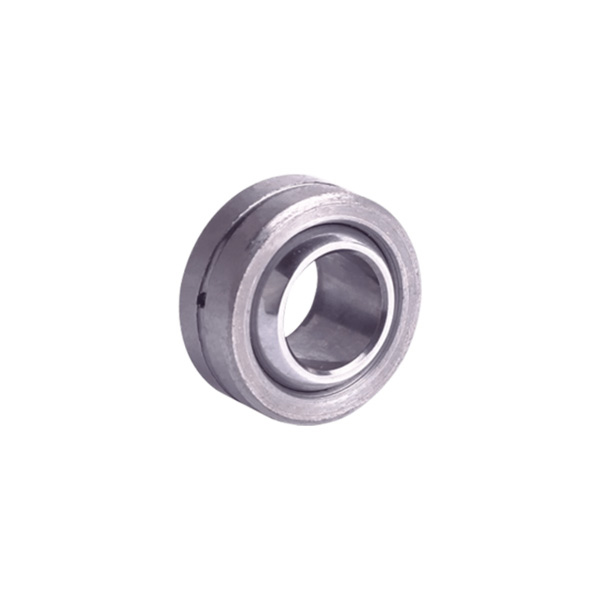
| COM / HCOM | Steel-to-steel; pressed carbon-steel outer ring; hard-chromium-plated GCr15 inner ring; lubrication groove and holes; inch dimensions | Maintenance-required | Trace the machine grease passage to the bearing groove and keep service access open |
| GE E / GE ES / GE ES-2RS | Steel-to-steel phosphated rings; axially split outer ring; ES has lubrication grooves and holes; 2RS adds seals on both sides | Maintenance-required | Choose open or sealed form, specify grease and verify split orientation and housing support |
Source: Dongzhou live product pages checked September 11, 2026. Product-page language is reported as published, with unresolved units and size-system wording excluded or flagged.

8. What we need to choose the sliding system
A sample can show the old bearing's dimensions, construction and wear pattern. It cannot tell us how often the mechanism moved, whether the load reversed or whether the previous grease passage was blocked. Send the operating record with the sample whenever possible.
-
Motion
Oscillation and tilt angles, speed or frequency, dwell time, duty cycle and any rotation. -
Load
Radial and axial components, normal and peak values, shock, reversal and load while stationary. -
Maintenance reality
Manual, automatic or central lubrication; available interval; access after assembly; grease specification. -
Environment
Temperature, dust, water, cleaning chemicals, corrosion exposure and contamination severity. -
Installed geometry
Bore, outside diameter, widths, articulation clearance, shaft and housing fits, shoulders and grease channels. -
Acceptance limit
Required life, allowable play or torque, inspection method and consequence of joint failure.
Dongzhou states that it was established in 2006, has more than 300 precision machining machines and professional testing instruments, and develops non-standard products from customer drawings or samples. For a custom housing or bearing-related part, the drawing should show the lubrication route and inspection features as clearly as the nominal dimensions.
For the wider bearing definition, load direction and installation logic, use our spherical plain bearing design guide. The current Dongzhou radial bearing category provides the product-family starting points.
Dongzhou application review
Send the duty cycle with the old bearing code
Mark motion and load directions on the assembly drawing, then add the lubrication method, grease route, service access, contamination and acceptable joint clearance. Dongzhou can compare those inputs with its GE UK, G PW, COM/HCOM, COM..T/HCOM...T and GE ES-2RS constructions, or review non-standard geometry from your drawing or sample.
Frequently asked questions
What is a maintenance-free spherical plain bearing?
It is a spherical plain bearing with a self-lubricating sliding contact system, commonly a PTFE-based liner against a steel inner-ring surface. The bearing does not need routine relubrication when used within the limits of that design. It still needs suitable fits, sealing, inspection and replacement criteria.
Does maintenance-free mean the bearing never needs inspection?
No. Maintenance-free refers to the lubrication system, not the whole joint. Inspect the bearing and surrounding parts for increasing clearance, liner damage, contamination, corrosion, seal damage, housing movement and interference at the articulation extremes.
Can I grease a PTFE-lined spherical plain bearing?
Do not add grease unless the exact bearing manufacturer's instructions permit it. For steel-to-PTFE fabric and steel-to-PTFE sintered-bronze designs documented by SKF, external lubricant disturbs the PTFE transfer process and can shorten service life. Other PTFE composite systems may have different instructions.
Why do steel-to-steel spherical plain bearings need relubrication?
Fresh lubricant separates and protects the sliding surfaces, reduces friction and wear, and helps guard against corrosion and contaminants. The housing or shaft must provide a working grease route to the bearing groove or holes. The interval depends on the exact load, movement, temperature, contamination and lubricant.
Does 2RS mean a spherical plain bearing is maintenance-free?
No. The 2RS suffix identifies seals on both sides for the applicable series; it does not define the sliding pair. Dongzhou's GE ES-2RS page lists a sealed steel-to-steel bearing with lubrication grooves and holes, so it remains a maintenance-required route.
Which type lasts longer, PTFE-lined or steel-to-steel?
Neither type has a universal life advantage. A PTFE liner removes routine relubrication but wears as sliding distance accumulates. Steel-to-steel can suit severe load, shock or reversing duty when the lubricant reaches the contact and the maintenance plan is followed. Calculate life or permissible operation for the exact series and duty.
Sources checked
- Dongzhou radial spherical plain bearing range, its five linked product-family pages, and the Dongzhou company profile.
- SKF Spherical Plain Bearings and Rod Ends catalogue, official definitions, sliding-contact, inspection and lubrication guidance.
- Schaeffler Plain Bearings catalogue, official PTFE running-in, lubrication and dimensioning guidance.
- SKF: Loads, official distinction between dynamic sliding and static load cases.
- SKF: Mounting, official bearing-handling and installation guidance.