

A catalogue rating becomes useful only after it is matched to movement, load direction, sliding pair and duty cycle. This guide shows what the symbols mean, what they do not prove and what a factory needs to review a real application.
C is the basic dynamic load rating used in the manufacturer's life method when the bearing slides under load. C0 is the basic static load rating for stationary loading under stated support conditions. Neither is the machine's allowable load. Selection also needs the actual load vector, oscillation, speed, sliding pair, fit, housing support, lubrication, environment and required life.
A spherical plain bearing does not fail by rolling fatigue in the same way as a ball bearing. Its inner and outer rings slide over a broad spherical contact. That is why a bore-size match and a catalogue load number are not enough.
In factory enquiries, the missing item is often movement. A buyer sends “20 kN radial load” but not whether the joint is stationary, rocks two degrees every second, reverses under full load or swings occasionally during setup. Those cases can produce very different sliding distance, heat, lubricant behavior and liner wear.
1. C and C0 answer different questions
Basic dynamic load rating, C
A reference value used with the maker's calculation factors when relative sliding occurs under load. SKF describes C as being based on a specific load factor and the effective projected sliding area. It is not a promise that the bearing can run indefinitely at C.
Basic static load rating, C0
A reference for load without relative movement, subject to the maker's deformation, fracture, material and support assumptions. A weak shaft, thin housing or poor shoulder can become the limiting component before the bearing reaches that rating.
The official SKF spherical plain bearing catalogue also warns that load ratings from different manufacturers may not be directly comparable because their definitions and calculation bases can differ. Compare complete selection methods, not just the largest number in a table.
2. “Dynamic” means sliding under load
A constant load can be dynamic if the inner ring oscillates. A changing force does not automatically mean the contact is sliding. Start with the contact motion, then apply the exact supplier's rules for alternating or vibrating load.
| Application state | Primary check | Why | Commonly missed detail |
|---|---|---|---|
| Joint parked under load | Static capacity and surrounding-part strength | No intended relative sliding | Peak load, shock and housing support |
| Slow occasional articulation | Dynamic contact plus static peaks | Sliding distance is small but load may be high | Breakaway torque and long dwell corrosion |
| Continuous oscillation | Dynamic life and permissible operating region | Wear accumulates with movement | Actual angle, frequency and reversal |
| Variable cycle | Segmented duty calculation | High-load and high-speed periods contribute differently | A simple average hides damaging segments |
| High-frequency vibration | Supplier-specific special assessment | Small motion may disturb lubricant or concentrate wear | Micro-movement under constant load direction |
SKF's official load-selection guidance distinguishes dynamic and static conditions by sliding movement, with special attention to alternating or vibrating loads.
3. Life is built from pressure, velocity and sliding distance
Manufacturers use different equations and constants, but the physical inputs are similar. Load determines contact pressure. Bearing geometry and oscillation determine how far the surfaces slide. Frequency turns that motion into sliding velocity and accumulated distance. The sliding pair determines what pressure and velocity it can tolerate.
In SKF's method, p is specific bearing load, P is equivalent dynamic bearing load, C is the basic dynamic rating and K is a load factor for the sliding contact. Do not transplant this equation or its constants to another brand without its current instructions.
The input list that changes a calculation
- Equivalent bearing load: resolve radial and axial components using the supplier's method. Do not add them casually.
- Oscillation angle: state whether the drawing gives total swing or angle to each side of center.
- Frequency and dwell: give cycles per minute or a time-based motion profile, including pauses.
- Load history: separate normal, peak, shock, reversing and setup loads.
- Sliding pair: steel-to-steel, steel-to-PTFE fabric and other composites use different limits and life factors.
- Operating context: temperature at the bearing, contamination, corrosion, lubrication route, shaft and housing support all affect real service.
4. Break a variable duty cycle into segments
Suppose a linkage accelerates under a high load, runs through most of its stroke at a lower load, dwells, then returns with a different force. A single “average load” deletes the relationship between force and motion. It can also hide a shock at reversal.
- Map one complete machine cycle. Mark each period with a distinct load, direction, oscillation angle, frequency or dwell state.
- Calculate each moving segment. Use one manufacturer's current method and its factors for the exact bearing series and sliding pair.
- Check stationary peaks separately. Include shaft, pin, housing, shoulder and retaining-feature strength, not only C0.
- Combine damage only as the method directs. Do not invent a linear average or mix factors from two catalogues.
- Apply the machine's acceptance criteria. Required play, friction, inspection interval and consequence of failure can govern the final margin.
5. Basic rating life is not guaranteed service life
For spherical plain bearings, wear is unavoidable because the contact cannot maintain a complete separating lubricant film at all times. Internal clearance grows as material wears. A rating-life result is a laboratory-based engineering guideline tied to a defined increase in clearance or friction. It is not a warranty that every bearing reaches the same hour count.
Actual service life can be shorter because of abrasive contamination, water, corrosion, damaged seals, poor fits, housing distortion, misalignment beyond the available articulation, interrupted grease delivery or a duty cycle that differs from the calculation. Very long calculated lives deserve extra skepticism because small environmental effects can dominate over time.
This is also why “maintenance-free” does not mean “inspection-free.” For the choice between sliding systems, see maintenance-free vs maintenance-required spherical plain bearings. For the broader bearing distinction, see spherical plain bearings vs ball bearings.
6. Match the calculation to the actual Dongzhou construction
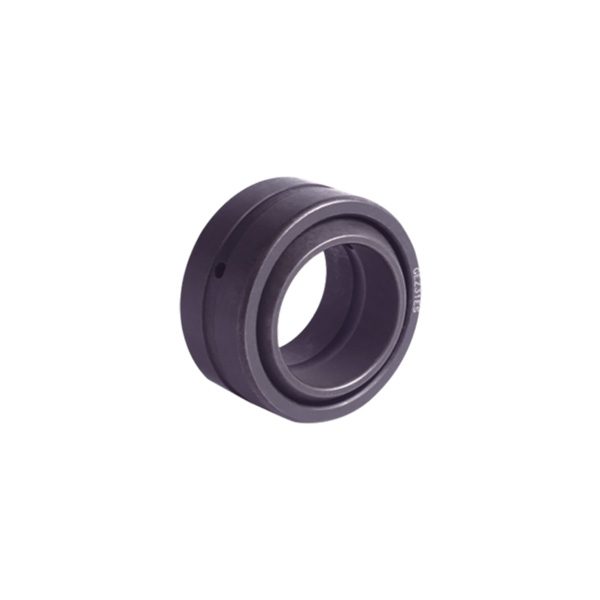

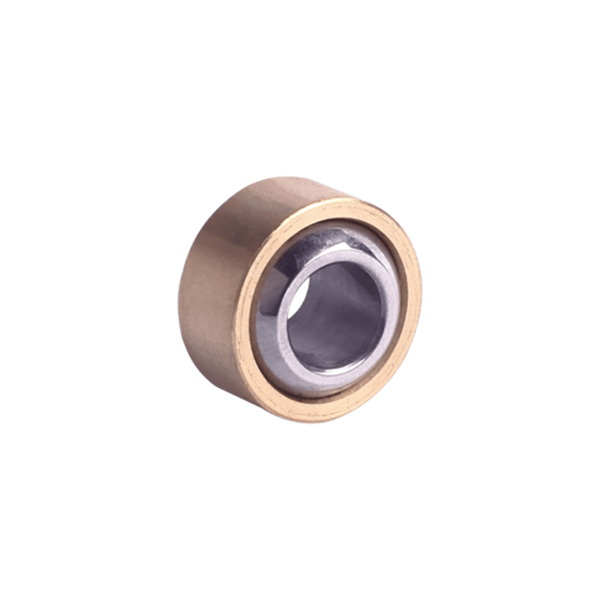
The suffix is not a minor ordering detail. It can change the sliding pair, seal arrangement, lubrication requirement and material. Start from the current Dongzhou radial spherical plain bearing range, then verify the exact construction before applying any rating or life method.
7. What our factory wants before reviewing a load case
At Dongzhou, we can learn more from one marked-up assembly drawing than from a long message saying “heavy duty.” The drawing tells us where the bearing sits, how it is supported and whether articulation will be blocked. The duty sheet tells us what happens at that joint over time.
- Assembly and bearing detail drawings, including shoulders, chamfers, seals and lubrication passages
- Normal, peak and shock loads, with radial and axial directions shown on the drawing
- Total oscillation angle, frequency, dwell time, reversals and expected operating hours or cycles
- Allowable radial play, running torque and end-of-life criterion
- Shaft and housing materials, fits, wall thickness and operating temperature at the joint
- Dust, water, chemicals, washdown, corrosion and maintenance access
Have a load spectrum and assembly drawing?
Send both, together with the required life and environment. Dongzhou can compare the geometry with its current bearing families or review a non-standard part from a supplied drawing or sample. We will not assign a load or life from bore size alone.
Request a drawing reviewAbout Ningbo Dongzhou Transmission | sale02@hkdongzhou.com | +86-574-87815807
Frequently asked questions
What is the dynamic load rating of a spherical plain bearing?
The basic dynamic load rating, commonly shown as C, is a manufacturer-defined reference used with load, sliding velocity, sliding pair and other factors in a rating-life calculation when the bearing moves under load. It is not a guaranteed working load or a universal value that can be compared across brands without checking each definition.
What is the static load rating of a spherical plain bearing?
The basic static load rating, commonly shown as C0, refers to the maximum permissible load under the manufacturer's stated stationary conditions and support assumptions. It is not automatically the allowable machine load because shaft strength, housing strength, edge loading, shock and safety requirements still apply.
Is a reversing load always a dynamic load?
Not by itself. The deciding question is whether sliding occurs between the rings while load is applied. A loaded bearing that oscillates is treated dynamically. A stationary joint with a changing force can require a different check, although high-frequency alternating or vibrating loads may need special dynamic treatment under the supplier's method.
Can spherical plain bearing life be stated in hours?
Yes, when the duty cycle is known, a manufacturer's method may express basic rating life in operating hours or oscillation cycles. Actual service life can differ because contamination, corrosion, fit, lubrication, temperature, complex motion and load history are not fully represented by a single laboratory-based calculation.
Can I average variable loads for a life calculation?
Do not use a simple arithmetic average unless the chosen manufacturer's method explicitly permits it. Divide the duty into load, speed and motion segments, calculate their contribution under that method, and include dwell, shock and reversal conditions separately.
What data should I send for a spherical plain bearing load review?
Send the assembly drawing, bearing envelope, radial and axial force directions, normal and peak loads, oscillation angle and frequency, dwell time, required life, sliding pair preference, lubrication plan, temperature, contaminants, shaft and housing materials, fits and the joint's allowable clearance or torque.