

Custom clevis and rod end RFQs: what a drawing must settle
A sample can tell us what one part looks like. It cannot tell us which differences the next hundred parts are allowed to have. That distinction is where a useful custom-parts inquiry begins.

Dongzhou lists custom non-standard parts, including custom hardware, linkages and stamping, and says it works from customer drawings or samples. That is an invitation to discuss the requirement, not a claim that every geometry, material or load case is already approved. Our recommendation is to begin with the nearest published part and make the difference explicit. It gives both buyer and factory a common reference while leaving room to challenge an assumption before tooling or production decisions are made.
First ask: catalogue variant or genuinely new part?
A nominal size is not an orderable specification. On Dongzhou's FK clevis page, the FK 8X16 and FK 8X16 FG rows share the same listed fork geometry, yet the regular row calls out M8×1.25 and the FG row M8×1. A photograph, or a note saying only “M8 clevis,” will not resolve that difference. The product page also shows that a longer fork variant such as FK 8X32 is a separate catalogue choice. Neither the thread pitch nor the fork length should be inferred from the bore alone.
| Question | Published starting point | What the buyer still needs to state |
|---|---|---|
| Is the thread standard for this model? | FK 8X16: M8×1.25; FK 8X16 FG: M8×1 in Dongzhou's table. | Thread hand, pitch, mating rod/thread and required engagement. Do not write only “M8.” |
| Is the geometry already catalogued? | The FK range lists separate short and long forms, including FK 8X16 and FK 8X32. | Fork bore, gap, center-to-end geometry, clearance envelope and any feature changed from the selected reference. |
| Is this a single part or an assembly? | Dongzhou says FK clevis assemblies with pins, bolts or circlips can be requested. | Exactly which fork, pin, washer and retainer are included; a part number or drawing for each. |
There is a similar code trap in Dongzhou's SI-TK rod end notes: the page uses L for a left-hand thread and FG for a fine-pitch thread. Those suffixes help identify a catalogue option, but the purchase drawing should still carry the full thread requirement. If a buyer swaps a clevis for a rod end, it is a change in joint function and mounting geometry, not merely a naming change.
The sample is useful, but it is not the authority
A physical sample can reveal general shape, assembly order and signs of contact or wear. It may also carry a plating layer, deformation or field repair. Measuring it tells us what that specimen is today. It does not establish the nominal design or the acceptable variation for new parts. A worn hole should not quietly become a new nominal bore; an unidentified finish should not become a material specification.
When sending a sample, label these unknowns
- Is it an approved production part, a prototype, or a failed field return?
- Which surfaces actually mate in the installed machine? Include the mating pin, eye or threaded rod if possible.
- Which features must be copied, and which are allowed to change?
- Do you have a drawing revision, measurement report or approved master sample that overrides this one piece?
This is a buyer-side review checklist, not a claim about Dongzhou's internal sample-approval procedure.
For a moving assembly, state the intended movement, not just the silhouette. A clevis pin allows rotation about its pin axis; a spherical rod end permits angular misalignment in multiple directions within the selected joint's limits. If the machine needs side movement, the drawing should show where it occurs. Our pneumatic connection guide explains the different joint roles; Dongzhou's customized-linkage page identifies connection and motion transfer as the purpose of a custom part. The operating envelope still belongs in the buyer's requirement.
Make the drawing a contract for fit, not a picture of shape
The strongest RFQ package has an assembly view for function and individual part drawings for manufacture. For a clevis-and-pin connection, locate the pivot axis and define the mating stack. For a rod-end linkage, define the pivot-center distance at the specified adjustment position and the required adjustment range. Where a dimension has a functional consequence, mark the tolerance and inspection method; a blanket “tight tolerance” note is not useful.
Define the interfaces before the noncritical contours
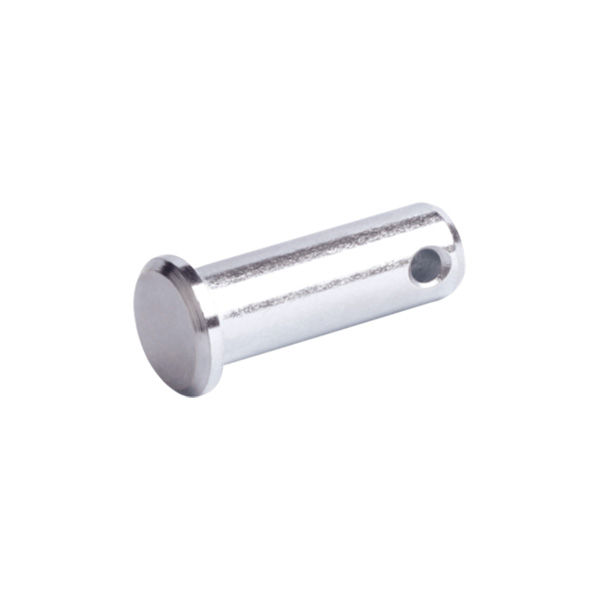
The bore, pin and fork gap work as a set. Specify the bore and pin limits, the usable pin length, the thickness and width of the mating eye, and the chosen retainer. The pin may be supplied separately: Dongzhou's PC bolt/pin line is a distinct product page. If the quote is for a completed joint, ask for the assembly drawing and bill of materials rather than assuming the photographed hardware is included.
Materials and finish belong to each component
Mark material grade and surface treatment at part level. Dongzhou's published FK and PC pages list material choices, but the fork's selection does not automatically specify the pin or clip. Also state whether a fit applies before or after coating. A coating can change a close-fitting bore or pin. If the environment makes corrosion performance critical, define an applicable test or acceptance requirement rather than the vague phrase “rust proof.”
For a spherical joint, define the bearing construction and the motion/load requirement independently from body material. Dongzhou's SI-TK page lists separate body, ball and inner-ring materials. Changing one is not permission to assume the others change with it.
Put load, movement and environment on the same page
Give the operating force direction, maximum and repeating loads if known, frequency of movement, allowable angular travel, temperature and exposure to water, chemicals or debris. These inputs do not turn a catalogue entry into a validated load rating. They tell the supplier what must be reviewed and where the current specification is incomplete. If a safety-critical application needs verification, request a documented engineering review and agreed test plan for the actual configuration.
When position or orientation has to be controlled, name datum features and the required geometric tolerance rather than leaving the meaning to a general note. ASME Y14.5-2018 (R2024) provides the drawing language for dimensioning and geometric tolerancing; citing it does not mean Dongzhou or a proposed part is certified to a standard.
Agree how the first article will be accepted
A drawing is only actionable when its critical features can be checked. Identify the characteristics that matter to the machine, the measuring condition, and the acceptance rule. For example, a buyer might require the assembled pivot-center distance to be checked at a defined adjustment position, the thread to be verified with the specified gauge, and the fork/pin fit to be assessed after finishing. Those are suggested controls to agree with the supplier, not Dongzhou's published default inspection plan.
Ask for a proposed first-article inspection record on the agreed critical dimensions. If performance needs proof, state the load direction, fixture, cycle or static condition and pass/fail rule before asking for a test. “Tested” without conditions says little. It is equally important to distinguish a sample approval from approval of the drawing: if the approved sample and revision-controlled drawing disagree, the buyer and supplier need a written decision about which controls production.
A concise RFQ Dongzhou can actually review
Start with a link to the nearest Dongzhou product, such as the FK clevis, SI-TK rod end or customized linkage page. Attach a PDF drawing with revision and units; add a 3D model only if it helps show the geometry. State the supply boundary, application, annual or batch demand as an estimate, sample availability and required documentation. If the design is still open, say which values are targets and which are hard limits.
“Please review a custom clevis assembly based on your FK 8X16 family. The attached revision B drawing controls the fork, mating eye, pin and retainer. We need the thread form and hand exactly as shown, the specified finished pin fit, and the stated operating movement. Please identify any conflict between the drawing and your standard components, quote fork-only and complete-assembly options separately, and propose how the marked critical dimensions would be inspected. A physical sample is available for reference; the drawing controls if they disagree.”
Illustrative inquiry language only. It describes no completed Dongzhou order or approved capability.
This is the point where a factory perspective is useful: a good question is often more valuable than an instant “yes.” If the mating eye, thread pitch or load path is uncertain, resolving it before the quote protects the buyer from approving a beautifully made part that cannot be installed.
FAQ
Is a physical sample enough to quote a custom clevis?
A sample can establish a starting geometry, but it cannot by itself confirm the intended thread hand and pitch, material grade, finish, functional tolerances or acceptance criteria. Send a drawing or an annotated requirement sheet with the sample.
Should I specify a complete clevis assembly or only the fork?
State the supply boundary explicitly. If the pin, washer, retaining clip or mating eye must be included, identify each part and its material, finish and inspection requirements. A fork-only quotation should not be treated as an assembly quotation.
Which dimensions should be marked critical on a linkage drawing?
Start with the features that locate and connect the assembly: pivot-center distance, bore and pin fit, fork gap and mating-eye thickness, thread specification and engagement, and the required movement and load direction. Define allowable variation and how each critical feature will be checked.