

Gas spring end fittings and brackets: choose both pivot centers
A ball socket or clevis is only half the mounting choice. The bracket puts its pivot in space, and that position determines what the joint must do through the full movement.
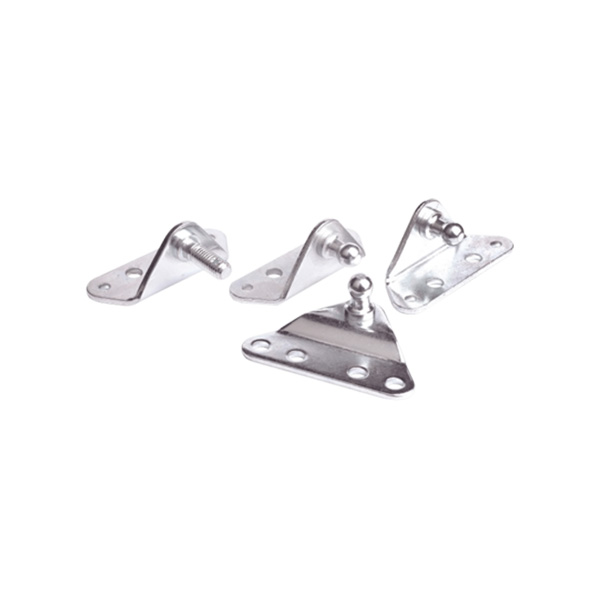
Specify a gas spring from the installed geometry outward. Mark the fixed pivot and the moving pivot at both end positions, then check their separation through the full sweep. Choose an end fitting at each pivot that accommodates the required movement. Check the socket or eye, its mating stud or pin, the bracket and retention as one assembly.
Begin with the two positions of the mechanism
For a lid, guard or hatch, one gas spring end is usually attached to the fixed frame and the other to the moving member. The moving bracket follows an arc. The straight-line distance between the two pivot centers therefore changes, as does the angle at which the end fitting meets its bracket.
Mark the fixed pivot F and the moving pivot at the closed and open positions, Pclosed and Popen. The installed center distance at any position is the straight line from F to P. With two-dimensional CAD coordinates, calculate it as L = sqrt((xF - xP)^2 + (yF - yP)^2). Sweep P between the end positions too: the shortest or longest distance can occur between the stops, depending on bracket placement. This is a geometry check; it does not calculate gas spring force.
Take the minimum and maximum center distances over the full sweep to the gas spring supplier along with the spring's installed-length limits. Verify that the mechanism's own stops do not force the gas spring or an end fitting beyond its permitted travel. If the mounting geometry changes, repeat the check. A bracket swap can change the effective stroke without changing the spring itself.
Choose the end joint from the movement it must allow
Dongzhou offers more than one way to attach the same kind of moving member. A clevis pin forms a hinge about one pin axis. A ball socket and stud allow angular movement about the ball, within the specific joint's limits. Neither choice removes the need to align the bracket and verify the allowable load for the selected assembly.
| Connection route | Dongzhou parts to examine | Best reason to consider it | Draw the interface that controls it |
|---|---|---|---|
| Pinned clevis and eye | FK or FT gas spring fork assembly with a mating FE eye | The motion stays mainly in a known plane and a removable pin is useful. | Pin axis, fork gap, eye width, pin and clip, and the thread at each end. |
| Ball socket and stud | DIN 71805 socket, DIN 71803 stud and an appropriate bracket | The mounting requires angular swing outside one ideal hinge plane. | Ball size, both mounting ends, socket retention, swing clearance and bracket pivot center. |
| Stud carried by a bracket | BRK or BDK gas spring bracket plus the specified mating socket | The frame or panel needs a defined mounting footprint and ball-pivot position. | Fastener pattern, plate orientation, stud location and clearance for the socket and clip. |


The three DIN numbers describe different supply scopes. DIN Media calls DIN 71805 the housing and circlip standard, while DIN 71803 concerns ball studs with screw or rivet studs. Those document titles help identify the component. They do not establish that an arbitrary socket, stud and bracket form a verified gas spring assembly.
A real FE eye example: the bore matches, the thread does not
The Dongzhou FE eye table gives a particularly useful check. FE 8X16 and FE 8X16 FG both list an 8 mm d1 eye bore. The standard-thread row gives M8×1.25; the FG row gives M8×1. A correct pin size does not make the threaded end interchangeable.
| FE catalogue row | Eye bore d1 | Thread listed | What must match on the spring or mating part |
|---|---|---|---|
| FE 8X16 | 8 mm | M8×1.25 | Full right- or left-hand thread callout and usable engagement. |
| FE 8X16 FG | 8 mm | M8×1 | The fine-pitch mating thread, not just the nominal M8 diameter. |
The FE page also lists left-hand thread codes. On an inquiry, state pitch and hand as separate facts, then mark the eye width, pin, fork width and retainer on the assembly drawing. From a factory review perspective, that removes two common ambiguities in one step: which thread goes onto the rod, and which hardware closes the pivot.

The bracket changes the spring's working geometry
A bracket drawing deserves the same attention as the end fitting. The Dongzhou gas spring bracket table lists BRK5558, BRK4263, BDK4266 and BDK4696. In the published table, BRK5558 and BRK4263 share many values but differ in columns A, B and O. The image alone does not reveal the resulting pivot coordinates.
| Dongzhou bracket | A | B | O | Selection consequence |
|---|---|---|---|---|
| BRK5558 | 19.2 | 29 | 6.6 | The rows differ. Compare the actual bracket drawing and installed ball center before replacing one with the other. |
| BRK4263 | 20 | 30 | 4.3 |
These are Dongzhou's printed column values, not a substitute for a dimensioned drawing. The public table does not define the symbols on this page or state a measurement unit beside its "Dimensions" heading. The controlled drawing should locate the ball center relative to the mounting holes and identify the hole sizes, plate thickness, fasteners and available tool access.
What the photo cannot settle
Dongzhou says these brackets are stamped and lists cold-rolled St12 sheet for the bracket. It lists Q235A with zinc plating for the ball stud and bolt. It does not make every photographed variant interchangeable. Ask for the selected BRK or BDK drawing and check the stud position, mounting pattern and material schedule for that exact assembly.
A bracket that fits the panel holes can still shift the ball center. That changes both the installed length and the approach angle at the socket.
Retention is a separate item on the drawing
Dongzhou's gas spring clevis assembly is described with a bolt and DIN 6799 safety clip. Its ball socket page offers a Type B version with a safety clip. These are different joints. The same word "clip" does not make their geometry or removal method equivalent.
DIN Media lists DIN 6799:2026-05 for retaining washers for shafts. That is a standards reference for the retainer form, not a force rating for a selected Dongzhou gas spring connection. Mark the exact pin groove or ball-socket clip configuration, access for installation and removal, and any required retention verification on the drawing.
Do not size the gas spring from these pages. The end-fitting and bracket listings provide component dimensions and options. They do not give the required spring force, stroke, damping, installed length or allowable side load for a particular hatch. Those values belong to the gas spring and machine design, then need checking against the selected mounting hardware.
A drawing package Dongzhou can actually review
Dongzhou's company profile says it develops non-standard parts from customer drawings or samples. For a gas spring connection, the most useful input is a side view of the mechanism at both stops with the pivot centers marked. A sample of a loose fitting may show the thread and shape, but it cannot show where the two mounted pivots must be.
Put these facts on one assembly sheet
- Mechanism
- Fixed frame, moving panel, hinge center, closed position and open position.
- Pivot coordinates
- Frame bracket ball or pin center, plus the moving bracket path between both stops.
- Installed lengths
- Minimum and maximum center-to-center distances over the sweep and the spring maker's allowable installed range.
- End hardware
- Socket and stud or clevis, eye and pin at each end; thread pitch, hand, size and retainer.
- Operating envelope
- Spring force and direction from the gas spring specification, movement path, side clearance and exposure conditions.
- Order control
- Dongzhou part numbers or drawings, material and finish, quantity, inspection requirements and drawing revision.
Our manufacturing view is simple: approve the pivot positions and the mating interfaces together. If a designer moves a stud bracket after the gas spring is selected, the spring's end distances and joint angles change. Revising the bracket drawing without rechecking those two results leaves a gap in the assembly approval.
For the wider cylinder connection family, Dongzhou's published pneumatic cylinder accessories guide explains clevises, pins and floating joints. This page focuses on the additional gas spring problem: two changing pivot centers and the brackets that locate them.
Send Dongzhou the two-position mounting drawing
Include the gas spring's open and closed pivot centers, the chosen socket or clevis at each end, bracket model, full thread callouts and retention choice. Ningbo Dongzhou Transmission Co., Ltd. can compare them with its current FE, FK/FT, ball-joint and BRK/BDK ranges or review a non-standard bracket from your drawing.
Questions from buyers and designers
Can I select a gas spring end fitting from its thread size alone?
No. Confirm the complete thread callout, the pivot type at each end, the location of both pivot centers, the joint's available movement, retention, and the minimum and maximum mounting distances over the full sweep. A matching thread alone does not establish the correct mounting geometry.
Are Dongzhou FE 8X16 and FE 8X16 FG the same connection?
They share the listed 8 mm eye bore, but the FE table gives M8 x 1.25 for FE 8X16 and M8 x 1 for FE 8X16 FG. The fine-pitch version must match the actual mating thread. Confirm the current drawings before treating the parts as substitutes.
Can a BRK5558 bracket replace a BRK4263 bracket?
The published bracket table lists different A, B and O values for BRK5558 and BRK4263. Their product photo does not establish interchangeable pivot locations or mounting interfaces. Compare the current bracket drawings and both installed pivot-center positions before substitution.
Sources and drawing scope
Product dimensions and configurations come from Dongzhou's linked FE eye, gas spring clevis, bracket, socket and stud pages. The DIN Media links above confirm document titles and status. The pivot diagram and length method are explanatory geometry, not a Dongzhou installation drawing or a tested load calculation.