

Direct Answer
A rod end bearing is a threaded, self-aligning joint with a spherical plain bearing set in its head, letting a linkage pivot and absorb misalignment while it carries load. What actually separates one rod end from another is three choices — the thread (male or female), the construction (2-, 3- or 4-piece), and the bearing surface (maintenance-free PTFE or steel-on-steel that needs grease). Choose on those three, not on brochure adjectives.
Search "what is a rod end bearing" and you get the same paragraph a dozen times: a spherical bearing in a threaded eye, used in steering and hydraulics, available in "various sizes and materials." All true, and none of it tells you which part to buy.
We manufacture rod ends, so we see the gap from the other side. The questions that actually decide a purchase — is this a 2-piece or 4-piece build, does it run dry or need a grease nipple, what are the real load numbers for this bore — are the ones most guides skip. This page fills them in, with the real construction and specification detail behind each type.
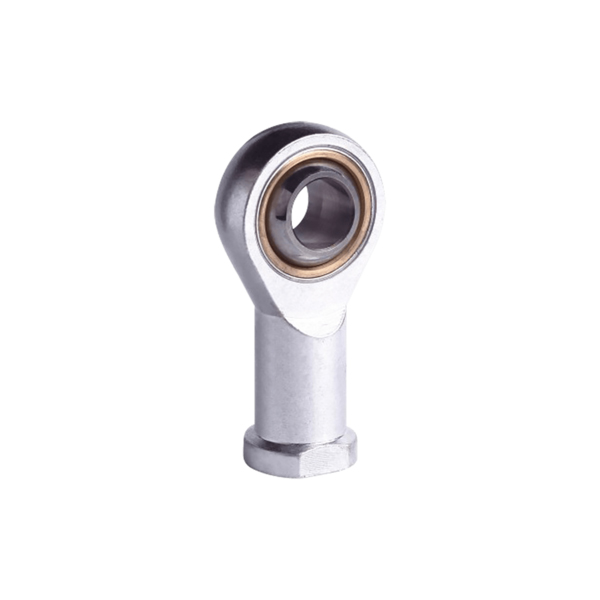
01What a Rod End Bearing Actually Is
Every real linkage has a problem: two pivot points are never perfectly parallel. Build a tie rod, a four-bar linkage or a cylinder mount on plain pin joints, and the smallest mounting error binds the mechanism, side-loads the pin and wears the bore oval in service.
A rod end bearing solves that in one part. It buries a hardened ball inside the eye of a threaded shank. The ball carries a through-bore for the mounting bolt and rotates freely in its race, so the joint self-aligns — it swallows angular misalignment, a little axial offset and small twist while still transferring the load. That is the whole point of the part, and it is why rod ends are also called heim joints (North America) or rose joints (UK): different names, same component.
Because the pivoting element inside a rod end is a spherical plain bearing, the two terms are often confused. The distinction is simple: a spherical plain bearing is the ball-and-race unit on its own; a rod end is that unit built into a threaded body so it can be bolted straight onto a rod. Every rod end contains a spherical plain bearing — the body and thread are what make it a joint.
02The Parts of a Rod End
Strip a rod end down and you find five functional parts. Knowing them makes every part number and datasheet readable.
- Body (the eye / housing). The eye-shaped head with an integral threaded shank. On our standard range it is medium-carbon steel 45 with zinc plating; a stainless option (304, 303 or 316, passivated) is available where corrosion matters.
- Ball (inner ring). The load-carrying sphere with the bolt bore through it. Typically bearing steel GCr15, or hard-chrome-plated / 440C stainless for corrosive service.
- Race (outer seat). The concave seat the ball rotates against, inside the eye.
- Liner or bearing surface. This is the part that decides service life. It is either a self-lubricating PTFE or PTFE-bronze layer (maintenance-free) or a steel / high-duty-bronze surface fed by grease (maintenance-required).
- Thread (the shank). External or internal, metric or imperial, right- or left-hand, standard or fine pitch — the interface to the rest of your assembly.
Two of these — the thread and the liner — carry most of the buying decision. The next three sections take them in turn.
03Male vs Female Rod Ends
The first fork is the thread location, and it is set entirely by the part the rod end mates to.
A male rod end has an external thread on its shank and screws into a tapped hole or a mating internal thread. It is compact and mounts into a threaded boss — common on steering links, cylinder rods and control rods. In our range, the SA and SA-TK families are male.
A female rod end has an internal thread in its shank and receives a stud or threaded rod. It is used where you want to fine-tune length or attach to a moving member — the SI and SI-TK families are female.
Neither is "better." You match the rod end thread to whatever it connects to, then confirm bore, pitch and hand. For a full walk-through of the trade-off, see male vs female rod end bearings.

04How Rod Ends Are Built: 2-, 3- and 4-Piece Construction
This is the detail most guides leave out, and it is the one that tells you the most about quality and rebuildability. Rod ends are built in a few construction styles, usually described by piece count.
- 2-piece (economy, steel-on-steel). A forged body swaged around a spherical plain bearing (for example our maintenance-required ES family, built on a GE…ES bearing). Cheapest and rebuildable with a smear of grease, but a steel-on-steel joint develops measurable radial play after cyclic loading. Right for low-cost, low-cycle, greasable jobs.
- 3-piece. Body, ball and a separate bronze or lined element — for example our POS male range: steel on high-duty bronze, lubricated through a nipple or hole, and built to take high radial and axial alternating loads.
- 4-piece (precision). Body, ball, inner ring and a dedicated liner assembled to closer tolerance — our SI-TK and SA-TK ranges to ISO 1224-4K. This construction supports the self-lubricating PTFE liner and holds alignment better over life.
The takeaway for a buyer: piece count is a proxy for tolerance and service life. A 4-piece maintenance-free rod end and a 2-piece greasable one can share a bore size and thread and behave completely differently in service. If a supplier will not tell you the construction, that is worth asking about before you compare prices.
05Maintenance-Free vs Maintenance-Required
If you remember one distinction from this page, make it this one. It sets the running cost and the service life of the joint.
Maintenance-free rod ends run on a self-lubricating liner — a PTFE or PTFE-bronze composite between ball and race. They run dry, need no grease and no relubrication schedule, and suit sealed or hard-to-reach positions. Our SI-TK, SA-TK, SI-PK and SA-PK ranges are maintenance-free.
Maintenance-required rod ends run steel-on-steel or steel-on-bronze and carry a grease nipple or hole. They are lower cost, rebuildable and tolerant of shock, but they must be lubricated on schedule, and a missed interval shortens life fast. Our ES, PHS and POS ranges are maintenance-required.
We make and rebuild both, and we will say plainly: neither is universally superior. Maintenance-free wins on sealed, low-service, clean-running positions; greasable wins where cost matters, shock is high, or the joint is easy to reach and someone will actually grease it. The honest failure mode is a maintenance-required joint that never gets greased. The full comparison — with the wear behaviour of each — is in maintenance-free vs greased rod ends.

06How to Read a Rod End: Standards, Codes & a Real Size Table
Rod end part numbers look cryptic until you know the system. Our SI-TK range follows ISO 1224-4K, and the code carries the information you need.
- SI / SA — female (SI) or male (SA) body.
- The number — the bore diameter d in millimetres (SI 8 = 8 mm bore).
- Suffix L — left-hand thread (e.g. SIL 8T/K).
- Suffix FG — fine-pitch thread (e.g. SI 8T/KFG).
- Suffix 2RS — sealed both sides against contamination.
Left-hand and fine-pitch options exist because turnbuckle-style linkages adjust length by turning the rod end without dismantling the assembly. Below is a genuine excerpt from our SI-TK table — the kind of real data a datasheet should give you, not a "various sizes" line.
| Part No. | Bore d (mm) | Thread d3 | Dyn. load C | Stat. load C₀ | Weight (kg) |
|---|---|---|---|---|---|
| SI 5 T/K | 5 | M5 × 0.8 | 5.70 | 6.00 | 0.016 |
| SI 8 T/K | 8 | M8 × 1.25 | 11.6 | 12.9 | 0.047 |
| SI 12 T/K | 12 | M12 × 1.75 | 17.0 | 24.0 | 0.100 |
| SI 16 T/K | 16 | M16 × 2.0 | 28.5 | 39.0 | 0.220 |
| SI 20 T/K | 20 | M20 × 2.5 | 42.5 | 57.0 | 0.420 |
| SI 30 T/KFG | 30 | M30 × 2.0 | 88.0 | 114.0 | 1.100 |
Excerpt from the Dongzhou SI-TK (ISO 1224-4K) range; the full table runs 5–50 mm bore. Dynamic (C) and static (C₀) ratings follow ISO convention in kN — confirm units and the complete range against the product page or catalogue when specifying.
Buyer tip Size from the rating for your exact part number and load case, not a headline figure. A 5 mm bore and a 30 mm bore in the same family differ by more than an order of magnitude in load capacity. See the full range on the SI-TK product page.
07Where Rod End Bearings Are Used
Rod ends appear anywhere a linkage has to pivot under load while tolerating real mounting error. The same part — different size, liner and thread — solves problems across very different machines:
- Hydraulic and pneumatic cylinders — rod-end and cap-end mounts that must self-align as the cylinder swings.
- Construction and agricultural equipment — control rods, levers and linkages exposed to shock, dust and weather (where a sealed maintenance-free type earns its cost).
- Steering and suspension linkages — tie rods and drop links needing precise, backlash-free articulation.
- Industrial and precision machinery — automation arms, textile and packaging equipment, test rigs.
- Recreational and specialty vehicles — adjustable linkages using left-hand / right-hand thread pairs.
Because the demands differ so much, the right rod end is defined by the application, not the catalogue. When the standard range does not fit, we also build non-standard rod ends to sample or drawing.
Need help matching a rod end to your linkage?
Send us the bore, thread, load case and environment — or a drawing — and our engineers will confirm the right construction, liner and size from our ISO 1224-4K range, with the full load table. We reply within 24 hours.
Get a rod end recommendation08Frequently Asked Questions
What is the difference between a rod end bearing and a spherical plain bearing?
A spherical plain bearing is the ball-and-race element that carries the load and allows misalignment. A rod end bearing is that same spherical plain bearing built into a threaded eye-shaped body, so it can be screwed straight onto a rod or into a linkage. In other words, every rod end contains a spherical plain bearing; the body and thread are what turn it into a bolt-on joint.
Is a heim joint the same as a rod end bearing?
Yes. Heim joint is the common North American name for a rod end bearing, and rose joint is the British term. All three describe the same part: a threaded shank with a self-aligning spherical bearing in the eye. The name changes by region and industry, but the component is the same.
What does maintenance-free mean on a rod end?
Maintenance-free means the bearing surface is self-lubricating, usually a PTFE liner or a PTFE-bronze composite between the ball and the race. It runs dry, needs no grease and no relubrication over its service life. A maintenance-required rod end runs steel-on-steel or steel-on-bronze and has a grease nipple or hole, so it must be lubricated on a schedule.
How do I know if I need a male or female rod end?
It depends on the mating part. A male rod end has an external thread on its shank and screws into a tapped hole. A female rod end has an internal thread in its shank and receives a stud or threaded rod. Match the rod end thread to whatever it connects to, and confirm bore, thread pitch and hand before ordering.
What do the suffixes L, FG and 2RS mean on a rod end part number?
On Dongzhou rod ends, L means a left-hand thread (for example SIL 8T/K), FG means a fine-pitch thread (for example SI 8T/KFG), and 2RS means the bearing is sealed on both sides against contamination. Left-hand and fine-pitch threads are common on turnbuckle-style linkages where length is adjusted without dismantling the assembly.
How much load can a rod end bearing take?
It scales with bore size. Each size carries a published dynamic load rating (C) and static load rating (C0); for example, in the Dongzhou SI-TK range a 5 mm bore is rated far lower than a 50 mm bore. Always size from the actual rating for your part number and load case rather than a general figure, and ask for the catalogue table when you request a quote.