

A worn rod end tells a story. The pattern of play, binding, corrosion or cracking usually points back to the load path, mounting, environment or maintenance plan.
The most common rod end bearing failures are excessive play, worn or damaged liner material, stiff movement, corrosion, loose threads or hardware, a cracked eye and a bent or fractured shank. From our factory's point of view, the failed part is only half the evidence. We trace the symptom back through load direction, articulation, lubrication, contamination, thread engagement, pin fit and bracket geometry before recommending the same part again.
This guide is about the articulated linkage joint also known as a rod end or Heim joint. It is not about the connecting-rod bearing inside an engine. That distinction matters because search results often mix the two, while their construction, lubrication and failure analysis are completely different.
Our view is simple: replacing a damaged rod end without finding the cause is not a repair. It is a reset of the same failure clock.
1. Start with the symptom, not the part number
When a returned joint is described only as "worn" or "broken," the useful information is still missing. We first want to know what changed in the machine and where the change appeared.
2. Excessive play usually points to wear, but define "excessive" first
PTFE-lined bearings do not remain mechanically identical from the first cycle to the last. NHBB's engineering reference explains that rotational preload decreases and clearance increases with use. It also notes that increased radial and axial play can signal approaching liner failure. The actual failure point, however, depends on the system's allowable torque and clearance.
That is why we do not accept "it has some play" as a complete failure report. We need the original part number, service time or cycle history if available, a repeatable measurement method and the machine's acceptable movement.
- Normal run-in is not automatically failure. A small early change can occur as contact surfaces settle.
- Progressive clearance is the important trend. Record the same measurement at planned intervals.
- Liner debris alone is not a verdict. NHBB specifically cautions that visible debris does not by itself prove failure.
- Ball-to-race contact is a serious endpoint. A worn-through liner no longer provides the intended sliding system.
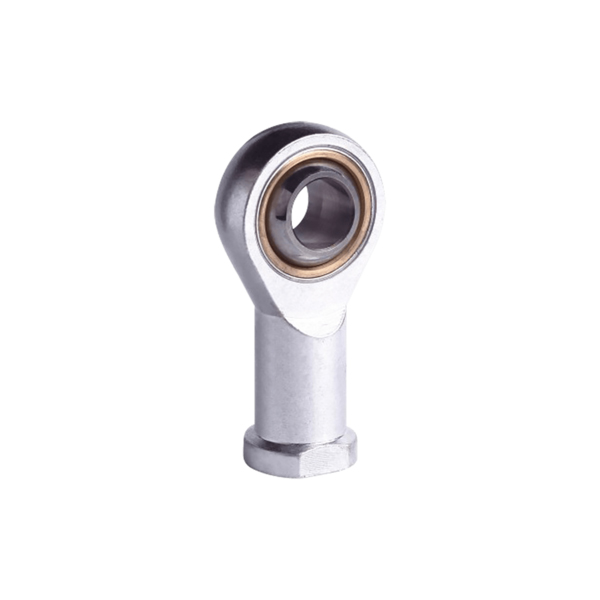
For maintenance-free applications, Dongzhou lists SI-TK female rod ends and SA-TK male rod ends as four-piece PTFE-lined families. The correct wear judgment must be tied to that exact construction, not borrowed from a steel-on-bronze product.
3. The wrong lubrication plan can damage either type
A lubrication mistake starts when the part number is treated as unimportant. In our current range, maintenance-free and maintenance-required rod ends are different products, not two service options for the same joint.
| Dongzhou family | Connection | Live-site construction | Maintenance implication |
|---|---|---|---|
| SI-TK | Female | 4-piece, PTFE lined, maintenance-free | No routine relubrication provision stated |
| SA-TK | Male | 4-piece, PTFE lined, maintenance-free | No routine relubrication provision stated |
| PHS | Female | 3-piece, maintenance-required | Lubricated through a nipple or body hole |
| POS | Male | 3-piece, steel on high-duty bronze | Lubrication provision; intended for high alternating loads |
Construction descriptions are taken from the live Dongzhou product pages checked August 26, 2026. The pages do not publish one universal grease interval.
Our rule on the shop side is straightforward: identify the sliding pair before touching the grease gun. A PHS or POS joint that is never serviced can run dry and wear. A PTFE-lined SI-TK or SA-TK is designed to provide its own low-friction transfer film, so do not add grease unless the exact documentation or manufacturer approves it.
The grease type, quantity and interval depend on load, motion, temperature, contamination and service access. If a supplier gives one interval without asking about those conditions, the answer is incomplete. See the full maintenance-free versus greased rod end comparison.


4. Dirt, water and corrosion turn smooth sliding into abrasion
A rod end is exposed by design. The ball has to articulate, so dirt and moisture can reach the sliding interface if the machine environment and protection are not considered. NHBB notes that PTFE-liner wear rates may increase when movement occurs under contaminated conditions.
From a factory review, "outdoor use" is still too vague. We ask whether the joint sees washdown, road salt, fertilizer, metal dust, sand, cutting fluid or standing water. Each answer changes the material, sealing and maintenance discussion.
- Abrasive dust can become a grinding medium at the sliding surface.
- Water and chemicals can attack the body, ball, thread and mating hardware even when the joint still moves.
- Corroded threads can make adjustment impossible and reduce reliable engagement.
- Mixed materials in the bracket, pin and rod end need an environment-specific corrosion review.
Dongzhou's current SI-TK and SA-TK pages list zinc-plated medium-carbon-steel bodies as the standard description and stainless steel 304, 303 or 316 body options with passivation. Those are real ordering options, but they are not a promise that every stainless choice suits every chemical. State the exposure in the RFQ so material selection is deliberate.
5. A rod end accepts angular movement, not a bad load path
This is the failure cause we are most determined to catch before production. Buyers sometimes expect the spherical ball to correct any assembly error. It cannot. The ball accommodates articulation within its geometry; it does not make a bent bracket, offset spacer stack or side-loaded shank harmless.
When we review a drawing, we trace the force through the bracket, bolt, ball, eye and shank. If the force line misses the joint center, the shank sees bending. If the ball reaches the edge of its articulation during the stroke, contact concentrates near the edge. Both conditions can produce rapid wear even when the catalogue load number looks comfortable.
- Model or measure the full operating angle, including tolerance and installation error.
- Use spacers that support the joint without clamping or distorting the ball.
- Keep the main force as close as practical to the rod-end centerline.
- Check the assembly through the complete stroke, not only at the neutral position.
- Do not use articulation to compensate for a permanently offset linkage.
6. Overload, shock and reversing duty can crack the eye or shank
A rod end is not limited by the spherical bearing alone. NHBB's rod-end load reference lists the bolt, bearing element, eye, male or female shank and eye-to-shank transition among the possible limiting components. It also notes that body shape, hardness, lubrication holes and grooves can affect the rating.
Our position is firm: a static table value should never be copied into the machine drawing as the allowable working load. The real case must include peak force, direction, motion, reversals, shock and the surrounding hardware. If the application changes from steady tension to repeated tension-compression, the review changes with it.
A crack around the eye or a bent shank is not a wear adjustment. Stop the machine, preserve the failed part and inspect the mating bolt and bracket. The deeper load-rating logic is covered in rod end bearing static and dynamic load ratings.
7. Threads, bolts and brackets fail beside the bearing
Some failures blamed on the rod end begin outside it. A loose locknut allows the linkage length to change. Too little thread engagement raises stress. A bolt that is loose in the bore hammers the ball. A narrow or flexible bracket can bend the joint even when the rod end itself was sized correctly.
| Check point | What can go wrong | What we want on the drawing |
|---|---|---|
| Rod-end thread | Wrong pitch or hand, damaged flank, short engagement | Full thread callout, hand and engagement length |
| Locknut or locking method | Joint rotates or linkage length drifts | Locking method and assembly torque requirement |
| Bolt or pin | Clearance, fretting, wear or inadequate shear capacity | Diameter, material, fit and retention |
| Spacers and washers | Ball is clamped, unsupported or forced off center | Stack dimensions and bearing-face support |
| Bracket | Flexing, hole elongation, poor edge distance | Material, thickness, spacing and complete section |
That is why our preferred failure review includes the assembly drawing and the mating parts. A clean close-up of the rod end is useful, but it cannot show the load path that bent it.
8. Our factory-side prevention checklist
Most prevention work belongs before the purchase order. If the load, geometry and maintenance plan are clear, the product family becomes much easier to choose and the inspection plan becomes specific.
- Define the load case. State units, radial and axial components, working and peak force, shock and reversals.
- Confirm the full geometry. Give bore, thread, pitch, hand, center height, articulation and the available envelope.
- Select the sliding system. Choose maintenance-free PTFE or a maintenance-required metal pair based on duty and real service access.
- Design the mating hardware. Review the bolt, pin, spacers, bracket, locknut and thread engagement as part of the same load path.
- State the environment. Include temperature, dust, water, washdown, chemicals and corrosion exposure.
- Set measurable inspection limits. Define allowable play, torque, corrosion, thread damage and replacement criteria for the exact machine.
For a new selection, start with our rod end bearing selection guide. If standard geometry does not fit, Dongzhou states that it can develop non-standard parts from drawings or samples.
Failure review by Dongzhou in Ningbo
Send the failed joint, its mating parts and the drawing
A model number tells us what was installed. The wear pattern, bolt, spacers, bracket and load case tell us why it failed. Send clear photos of both sides, the full linkage drawing, working conditions and any change in play or motion. We can compare the evidence with our current rod-end families or review a non-standard geometry from your drawing or sample.
9. Frequently asked questions
What are the warning signs of a failing rod end bearing?
Common warning signs include increasing radial or axial play, rough or stiff movement, squeaking or grinding, visible corrosion, damaged threads, a loose locknut, liner debris, cracking around the eye, or a bent shank. A crack, permanent deformation, binding or rapidly increasing clearance calls for immediate removal from service and an engineering review.
How much play is acceptable in a rod end bearing?
There is no universal play limit for every rod end or machine. The acceptable value depends on the product, the original clearance or preload, the linkage accuracy and the machine's safety requirements. Measure movement consistently and compare it with the approved drawing, maintenance specification or manufacturer's acceptance limit.
Why does a rod end become stiff or noisy?
Stiffness or noise can come from contamination, corrosion, a dry maintenance-required sliding pair, edge loading, a bent shank, distorted mounting hardware or a ball operating near its articulation limit. Inspect the complete joint before assuming that adding grease will solve the problem.
Can a maintenance-free rod end bearing be greased?
A maintenance-free PTFE-lined rod end is designed to operate without routine relubrication. Do not add grease unless the exact product documentation or manufacturer approves it. First identify the construction, because Dongzhou SI-TK and SA-TK are maintenance-free lined families, while PHS and POS are maintenance-required families with lubrication provisions.
Why do rod end eyes or shanks crack?
Possible causes include overload, impact, reversing duty, shank bending, inadequate thread engagement, poor bracket support or a stress concentration in the eye-to-shank transition. The bearing, eye, shank, bolt and bracket form one load path, so the complete assembly must be checked.
Is a rod end bearing the same as an engine rod bearing?
No. This guide covers the articulated linkage joint also called a rod end or Heim joint. An engine connecting-rod bearing is a different plain bearing inside an internal-combustion engine and has different failure modes, lubrication and service procedures.
Sources and product data
- Dongzhou product construction: SI-TK maintenance-free female rod ends, SA-TK maintenance-free male rod ends, PHS maintenance-required female rod ends, and POS maintenance-required male rod ends.
- Dongzhou: company and manufacturing information and the current inquiry page.