

C and C0 are catalogue reference values for one exact series. The assembly still has to be checked for direction, motion, shock, angle and its weakest component.
A rod end table commonly lists dynamic C and static C0. Use C when evaluating a joint that moves or oscillates under load and C0 when checking a stationary load, but only under the manufacturer's stated definitions. Neither value is a complete-linkage rating. Check radial versus axial direction, load reversals, shock, misalignment, shank and eye strength, bolt and bracket capacity, liner or lubrication, and a suitable design margin.
The largest number in a catalogue row is not automatically the right purchasing answer. A rod end can be limited by the bearing element, eye, shank, transition radius, mounting bolt or surrounding bracket. The load can also change direction while the machine runs, which turns a simple static check into a wear and fatigue problem.
1. Ask four questions before reading C or C0
These questions determine whether the catalogue figure is even the correct figure to use. They also explain why an RFQ that says "load: 10" is not ready for review. The unit, direction, duty and peak condition are missing.
2. Static C0 and dynamic C answer different questions
NHBB's engineering reference defines static load as load supported while the bearing is stationary and dynamic load as load supported while it is moving. It also explains that an oscillating dynamic rating may be tied to a specified wear limit, frequency and amplitude. That detail matters: two dynamic figures are not comparable unless the definitions and test conditions match.
ISO 12240-4:1998 does not remove this manufacturer-specific work. ISO's public abstract says the standard covers dimensions, tolerances and radial internal clearances for spherical plain bearing rod ends. It does not say that every manufacturer derives C and C0 by one universal method.
3. Radial, axial and angular are not interchangeable
A radial load acts normal to the ball-bore axis. An axial load acts along that axis. Rod ends are commonly arranged so the main force passes through the shank and across the bore in the radial direction. Axial capacity depends on the bearing element, retention method and any bending moment applied to the rod end.
- Radial load passes across the bore and is normally the main published direction for a rod end.
- Axial load pushes or pulls along the bore axis and must be checked separately.
- Combined load needs an approved calculation or manufacturer review because one catalogue column cannot describe both components by itself.
- Reversing load repeatedly changes tension and compression and may control fatigue or wear even when neither peak exceeds a static reference.
4. The complete rod end is limited by its weakest component
NHBB lists several possible limits for a rod end: the bolt through the bore, the bearing element, the eye, the male or female shank stress area, and the transition between the shank and eye. Lubrication holes, grooves, body shape and hardness variation can also change the rating.
This is why a large spherical bearing inside a small or poorly supported housing does not create a high-capacity assembly. The surrounding bracket and fastener can become the limit first. A side load on the shank is especially important because a rod end intended for tension and compression can be forced into bending by poor geometry.
| Possible limit | What to verify | Typical document |
|---|---|---|
| Bearing element | Sliding pair, liner, lubrication and exact series rating | Manufacturer product table |
| Rod-end eye | Body material, eye section and transition geometry | Approved product drawing |
| Threaded shank or body | Male or female stress area, engagement and bending | Assembly calculation and drawing |
| Bolt or pin | Diameter, material, shear planes, fit and retention | Fastener specification |
| Mounting bracket | Hole bearing, section thickness, spacing and edge distance | Machine assembly drawing |
5. Reading the current Dongzhou C and C0 columns
Dongzhou's live SI-TK female rod end and POS male rod end pages both publish dynamic C and static C0 columns. The values below are copied from those tables to show the pattern across sizes and constructions.
| Nominal size | SI-TK dyn. C | SI-TK stat. C0 | POS dyn. C | POS stat. C0 |
|---|---|---|---|---|
| 8 | 11.6 | 12.9 | 7.20 | 11.6 |
| 12 | 17.0 | 24.0 | 13.4 | 17.0 |
| 16 | 28.5 | 39.0 | 21.6 | 28.5 |
| 20 | 42.5 | 57.0 | 31.5 | 52.5 |
| 25 | 68.0 | 85.0 | 47.5 | 68.0 |
| 30 | 88.0 | 114.0 | 64.0 | 88.0 |
Live website table values checked August 26, 2026. The product pages do not visibly label the load unit. Confirm the current Dongzhou catalogue, quotation or approved drawing before using any value in a calculation or PO.
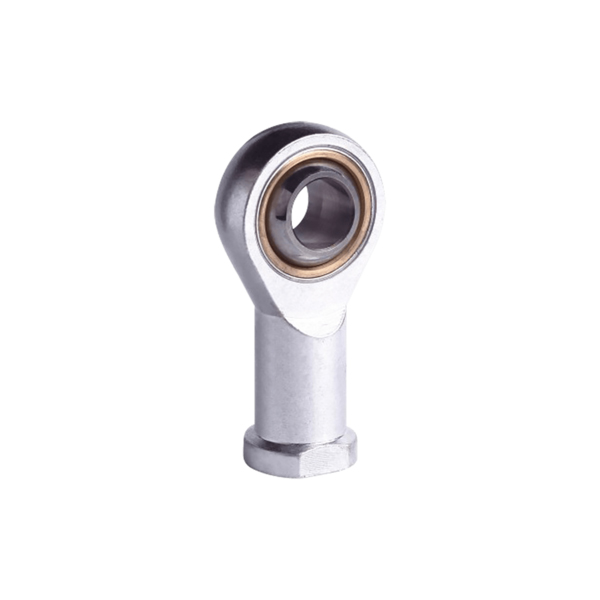
The two families also use different constructions. SI-TK is listed as a four-piece maintenance-free female series with PTFE lining. POS is listed as a three-piece, maintenance-required male series with steel on high-duty bronze and a lubrication hole or grease nipple. That difference is a reminder to compare complete part numbers, not only bore size.

6. A catalogue rating is not the allowable working load
C and C0 are inputs to selection. The allowable working load comes from the application, required margin and complete load path. Do not copy C or C0 into the "maximum working load" field of a drawing without checking the manufacturer's definition and the machine designer's calculation.
- Use the actual peak load and describe whether it is steady, alternating, vibrating or shock-loaded.
- Separate radial and axial components instead of combining them into an unlabeled single value.
- Include oscillation angle, frequency or cycle rate where motion controls wear.
- Check temperature, contamination, corrosion exposure and the maintenance plan.
- Review thread engagement, bolt or pin fit, spacers and bracket stiffness.
- Apply the design margin required by the machine owner, applicable standard and risk level.
The live rod end selection guide places load in the broader sequence with connection form, dimensions, articulation, liner and material. The maintenance-free versus greased comparison explains why duty and maintenance affect the construction choice.
7. Load information Dongzhou needs for a useful review
A factory cannot verify a rod end from one force value alone. Send the load case with the drawing so the table row, construction and mating hardware can be reviewed together.
- Required rod end family or an existing sample number
- Working, peak and shock loads with units
- Radial, axial or combined direction
- Steady, reversing or oscillating duty, including cycle information where available
- Required articulation and normal operating angle
- Bore, thread, pitch, hand, center height and available envelope
- Pin or bolt, spacers, bracket arrangement and thread engagement
- Liner or lubrication requirement, temperature, contamination and corrosion exposure
For a drawing that falls outside the standard series, Dongzhou states that it can develop non-standard products from drawings or samples. That review still depends on complete load and geometry information.
Load-case review by Dongzhou in Ningbo
Send the load path with the rod end drawing
Include the force units, direction, motion, peak condition, articulation and mounting hardware. We can compare the request with Dongzhou's current SI-TK, SA-TK or POS tables and flag any missing information before the part number is released.
8. Frequently asked questions
What does dynamic C mean in a rod end bearing table?
C is the manufacturer's dynamic load-rating reference for the stated series and rating method. It is used for a joint that moves or oscillates under load, but it is not automatically the permissible working load of the complete linkage.
What does static C0 mean for a rod end?
C0 is the manufacturer's static load-rating reference for a stationary joint under the stated rating definition. It still must be checked against load direction, shock, mounting hardware, shank and eye limits, and the required design margin.
Can rod end load ratings be compared directly between brands?
Only when the definitions, test conditions, units and product constructions are equivalent. Rating methods and limiting components can differ. Compare approved technical data for the exact part numbers rather than treating every C or C0 value as interchangeable.
Does a higher static rating guarantee longer service life?
No. Static strength and wear life answer different questions. Service life also depends on motion, load spectrum, lubrication or liner system, contamination, temperature, alignment and maintenance.
Is the catalogue misalignment angle an angular load rating?
No. The angle describes available articulation geometry. It does not state how much load the rod end may carry at every angle. Misalignment can change contact conditions and may introduce bending or edge loading elsewhere in the assembly.
What unit does Dongzhou use for C and C0 on the current website?
The live SI-TK, SA-TK and POS tables checked on August 26, 2026 label dyn. C and stat. C0 but do not visibly state the load unit. Confirm the current Dongzhou catalogue, quotation or approved drawing before using the values in a calculation or purchase order.
Sources and product data
- Dongzhou live tables: SI-TK maintenance-free female rod ends, SA-TK maintenance-free male rod ends, and POS maintenance-required male rod ends.
- Load terminology and rod-end limiting components: NHBB Engineering Reference, Load Ratings.
- Standard scope and current status: ISO 12240-4:1998.
- Dongzhou: company and manufacturing information and the current inquiry page.