

The useful question is not which industries use rod ends. It is what the joint must do at the end of the rod, under real load, movement and maintenance conditions.
Rod end bearings are used at the ends of rods, cylinders and linkages that must transmit push or pull load while accommodating angular movement. Common positions include hydraulic and pneumatic cylinders, steering or control rods, agricultural and construction linkages, and industrial mechanisms. A suitable application keeps the main load through the eye and shank, stays within the joint's articulation, and treats the bolt, bracket, thread, maintenance plan and environment as part of the design.
An RFQ that says only "M12 rod end for agricultural machinery" sounds specific, but it leaves out nearly every choice that controls performance. A guarded actuator link and an exposed steering link can sit on the same machine. One may move slowly in a clean enclosure. The other may reverse load, see dirt and water, and depend on a locknut that operators inspect.
From our factory side, the industry name starts the conversation. It does not select the rod end. We want to see the motion and the complete load path before we compare a drawing with the Dongzhou rod end range.
1. What job does a rod end bearing actually do?
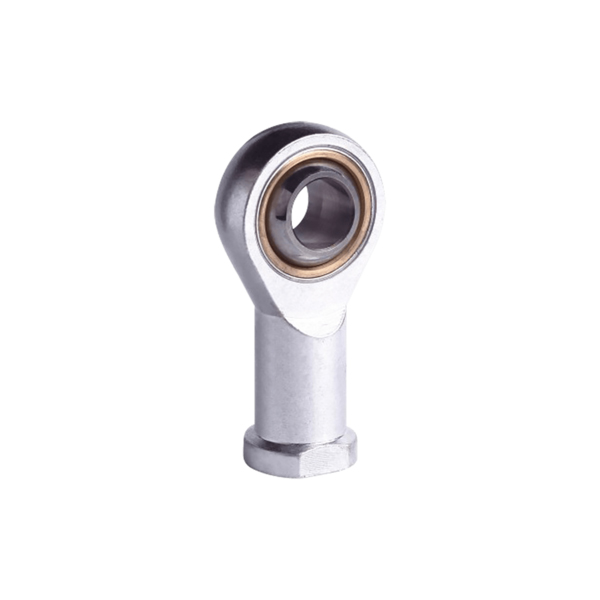
A rod end combines an eye-shaped housing, a spherical bearing and an integral threaded shank. SKF's rod end overview describes their primary use at hydraulic or pneumatic piston ends, joining the cylinder to an associated component. Different thread and shank forms make installation easier, while different sliding contact materials suit different operating conditions.
In practical terms, the joint solves four related problems:
- It terminates a rod or linkage. The threaded shank gives the designer a compact way to connect the joint to a tube, boss or actuator rod.
- It accepts angular articulation. The ball can tilt inside the housing as connected parts move through an arc or as alignment changes.
- It transfers load through a pin or bolt. The load travels from the mating rod into the shank, through the eye and bearing, and into the mounting hardware.
- It can provide length adjustment. Thread engagement and locknuts can set the effective center distance of a control link.
Angular freedom is not permission to misalign the whole machine. A rod end can accommodate the designed motion between two members. It should not be asked to straighten a badly positioned cylinder or carry a shank-bending load. If the distinction between the joint and its internal bearing is unclear, start with what a rod end bearing is and how it works.
2. Match the application problem before choosing a product family
This matrix is a shortlist, not a load approval. It shows how we move from the job in the machine to a construction worth reviewing. The exact bore, thread, load capacity and permissible angle still belong to the selected part and assembly.
| Motion and load problem | Typical position | Why a rod end fits | Question that changes the choice | Dongzhou family to review |
|---|---|---|---|---|
| Push and pull through an articulating connection | Hydraulic or pneumatic cylinder end | Compact connection with angular movement at the pin | What angle occurs at both stroke endpoints, and is the cylinder side-loaded? | SI-TK or PHS for a female connection; SA-TK or POS for a male connection |
| Small oscillation with in-place length adjustment | Steering, throttle, valve or control link | Threaded joint sets center distance while the ball handles changing angle | Does the link need opposed left-hand and right-hand threads for adjustment? | Male and female form chosen around the mating rod, maintenance and envelope |
| Shock, reversing load and contamination | Agricultural or construction linkage | Articulation prevents a rigid link from binding as geometry changes | Can the joint be greased and inspected, or must it run without routine service? | SA-TK, PHS, POS or a steel-on-steel SI-ES/SA-ES family, subject to exact duty |
| Repeated low-friction oscillation in a guarded area | Industrial automation or precision mechanism | Spherical movement tolerates modest alignment change in a compact joint | What play, running torque and positional accuracy can the mechanism accept? | Maintenance-free SI-TK, SA-TK, SI-PK or SA-PK |
| Exposed linkage with water or corrosive media | Outdoor equipment or process machinery | The joint format can work if its materials and protection suit the exposure | Which chemical, concentration, temperature and cleaning process reach the joint? | Stainless option or protected construction only after compatibility review |
Product families in this table are candidates for review. They are not interchangeable and do not share one universal rating.


3. Hydraulic cylinders, pneumatic cylinders and linear actuators
A cylinder rod travels in a straight line, while the driven arm often rotates around a pivot. The connection therefore changes angle during the stroke. A rod end lets the pin follow that angular change without making the rod-to-arm connection rigid.
The trap is using that freedom to cover up poor cylinder placement. At the factory-review stage, we want the pivot centers and the cylinder position at both ends of stroke. If the linkage drives the ball close to the housing edge, or if the cylinder axis sits away from the force line, the joint may see edge loading and the piston rod may see side load. A larger rod end does not correct that geometry.
For a cylinder connection, check these items before choosing a catalog number:
- tension and compression loads, including the pressure or external event that creates the peak;
- the angle at retracted, extended and neutral positions;
- whether the cylinder rod needs a female rod end or a male shank and adaptor;
- pin diameter, bracket spacing, spacers and whether the eye is supported on both sides;
- stroke frequency, maintenance access, dirt, water and temperature at the joint.
4. Adjustable steering, valve and control linkages
Rod ends are useful when a link must transmit motion accurately and its installed center distance needs adjustment. A locknut fixes the setting after the shank is threaded into the mating tube or component. With an opposed left-hand and right-hand pair, rotating the link can lengthen or shorten the assembly without removing both joint pins. Our guide to left-hand and right-hand rod ends explains that layout in detail.
These applications often reverse direction. That changes the review. Thread engagement, locknut retention, backlash, pin fit and bracket stiffness can matter as much as the nominal bore. If the mechanism controls steering, suspension or another safety-related function, the consequence of a loose joint also changes the inspection and validation requirement.
We do not treat "steering rod end" as a product specification. We ask whether the machine is an industrial cart, agricultural implement, off-road vehicle, road-going vehicle or another controlled system. A general-purpose industrial part is not automatically certified or approved for every one of those uses.
5. Agricultural, construction and other mobile-equipment linkages
Mobile equipment combines several difficult conditions: shock, reversing load, dirt, wash water, vibration and uneven inspection. A joint may move through only a small angle but still have a demanding life because every reversal crosses the same contact zone.
Dongzhou's current site lists construction and agricultural equipment among the applications for the maintenance-free SI-TK female family. It also describes the SA-TK male family for high shock and medium or heavy mechanical loads. Those descriptions help narrow the catalog, but they do not replace a size-level load and angle check.
There is also no rule that exposed equipment should always use a maintenance-free joint. Eliminating grease points is valuable when service is unreliable, yet a lined bearing still needs suitable protection from abrasive contamination and edge loading. Where scheduled lubrication is practical, a PHS or POS construction may deserve review. The comparison in maintenance-free versus greased rod ends is a better starting point than selecting on purchase price alone.
When we review this type of drawing, the most useful detail is often not the machine name. It is a photo or section view showing how the eye sits between the brackets. A narrow bracket, a long unsupported bolt or an offset spacer changes the load path outside the bearing.
6. Industrial automation and precision mechanisms
In guarded industrial equipment, the priorities can be different. The load may be moderate and contamination controlled, while repeatable motion, low friction, compact installation and low maintenance carry more weight. Dongzhou lists precision equipment among the applications for SI-TK. Its PTFE-lined, maintenance-free construction can be considered where the exact load, articulation and accuracy requirements fit.
Do not use "precision" as a shortcut for zero play. Every mechanism has an allowable positional error and running torque. The designer should convert that system requirement into a bearing-clearance and wear limit. If a small change at the rod end produces a large error at the tool, valve or sensor, inspection frequency and replacement criteria need to be defined before production.
Connection form also matters. A female rod end can shorten the assembly when the mating rod already has an external thread. A male rod end can simplify a tube or internally threaded boss. For pressed-body maintenance-free options, Dongzhou also lists SI-PK female rod ends and SA-PK male rod ends. Choose the envelope with the drawing, not from a product photo.
7. When a rod end is not the right joint
Rod ends are versatile, which makes them easy to apply by habit. We would stop and compare another joint in the following situations:
NHBB's rod end load-rating reference makes the complete-load-path issue explicit. Rod-end capacity can be limited by the bearing, eye, shank, transition area and other body features, while external pins, bolts and housings must be evaluated separately. That is why a catalog rating cannot validate the assembly on its own.
If an existing joint is showing play, binding, corrosion or deformation, use the rod end failure guide before ordering the same part again.
8. How we review a rod end application from a drawing
Good application review starts wider than the bearing. The drawing should show both pivot centers, the mating thread and enough of the bracket to reveal where the force goes. A sample can help identify geometry and construction, but it does not reveal the load or service environment by itself.
For a useful quotation or technical review, send:
- Function: what moves, what the link controls and what happens if clearance increases.
- Load: direction, units, normal value, peak value, tension or compression, shock and reversing duty.
- Motion: stroke, frequency, oscillation or rotation, plus the joint angle at every extreme position.
- Geometry: bore, full thread callout, thread hand, center height, engagement, envelope and nearby interference.
- Mounting: pin or bolt, bracket spacing, support on one or two sides, spacers and retention.
- Service: contamination, water, chemicals, temperature, maintenance access and inspection plan.
- Acceptance: required life, allowable play, running torque or positional error where those values matter.
Then we can compare the requirement with a standard family or review a non-standard geometry from the supplied drawing or sample. For the broader sizing process, see how to select a rod end bearing.
Application review by Dongzhou
Send the linkage, not just an industry label
If the request says only "M12 rod end for agriculture," we still have to guess. Mark the two pivot centers, stroke endpoints, load direction, full thread callout, available space and service access. Dongzhou can compare the requirement with current catalog families or review a non-standard part from your drawing or sample.
Frequently asked questions
What are rod end bearings used for?
Rod end bearings connect rods, cylinder ends and control links to a pin or bolt while allowing angular articulation. Typical positions include hydraulic and pneumatic cylinder connections, adjustable steering or control rods, mobile-equipment linkages and industrial mechanisms. The exact construction still depends on load, movement, maintenance, environment and connection geometry.
Why use a rod end instead of a clevis?
A rod end can accommodate angular misalignment in more than one plane and provides a compact threaded connection for adjustment. A clevis may be simpler when the joint needs rotation around one well-aligned pin axis only. The better choice depends on motion, load path, available space and wear strategy.
Can a rod end bearing be used on a hydraulic or pneumatic cylinder?
Yes. Rod ends are commonly used to join hydraulic or pneumatic piston ends to associated components because the spherical joint can accommodate angular movement. It should not be used to hide poor cylinder alignment. Check the complete load path, stroke-end angles, pin, bracket and side-load risk.
Are rod ends suitable for steering or suspension linkages?
They can be used in steering, control and suspension-type linkages when the specific part, installation and inspection plan are engineered for the duty. Reversing load, impact, thread retention, contamination and failure consequence all matter. A generic industrial rod end should not be treated as automatic approval for a road-going or safety-critical application.
Which rod end construction should be reviewed for shock or reversing loads?
Start by quantifying the peak and reversing load, articulation, maintenance access and contamination. Dongzhou describes SA-TK as a maintenance-free male family for high shock and medium or heavy mechanical loads, while PHS and POS are maintenance-required families with lubrication provisions. This is a shortlist for engineering review, not a substitute for checking the exact size and assembly.
When should a rod end bearing not be used?
Do not treat a rod end as the default when the shank will be bent, axial thrust dominates, continuous high-speed rotation is required, the joint operates beyond its articulation, or the surrounding bolt and bracket cannot support the load. A clevis, spherical plain bearing in a separate housing, rolling bearing or purpose-designed joint may fit better.