

A matching bore is a useful starting point for a replacement bearing. It is not an approval. With GE radial spherical plain bearings, the sliding contact, lubrication route and seals need separate checks, even when the principal dimensions match.
The short answer: Dongzhou's GE-E and GE-ES range uses steel-on-steel sliding contact. ES identifies the listed lubrication-groove and hole arrangement; ES-2RS adds seals on both sides. GE-UK uses a PTFE-lined sliding contact. Read these design clues alongside the complete part number and drawing, rather than treating them as a universal suffix dictionary.
| Series | Sliding contact | Lubrication / maintenance clue | Seal clue | First replacement question |
|---|---|---|---|---|
| GE-E | Steel / steel | Do not infer maintenance-free operation from the absence of ES lubrication features. | No 2RS designation. | What lubrication arrangement does this exact design require? |
| GE-ES | Steel / steel | Listed inner- and outer-ring lubrication grooves and holes. | Not the listed two-side-sealed variant. | Can lubricant reach the contact after installation? |
| GE-ES-2RS | Steel / steel | ES lubrication features remain a separate consideration. | Seals on both sides. | Are sealing, grease access and movement suitable together? |
| GE-UK | PTFE-lined | Dongzhou's maintenance-free range. | UK alone does not establish equivalent sealing. | Does the application suit this sliding system? |
Series descriptions here refer to Dongzhou's GE-E / GE-ES / GE-ES-2RS and GE-UK product ranges. Other manufacturers' designations need their own catalogue definitions.
How to Read a Radial Spherical Plain Bearing Code and Diagram
Start with a complete designation, such as GE20ES-2RS. Dongzhou lists this part alongside GE20ES. Removing the final suffix from an order removes information about the intended sealing arrangement.
Keep ES together when interpreting the design. A letter-by-letter explanation taken from a different bearing family can be misleading. Likewise, do not apply a rolling-bearing bore-code multiplier: the actual GE20ES-2RS row gives d = 20 mm.
Read the bearing diagram before reading across the table
In Dongzhou's tables, d is the bore, D the outside diameter, B the inner-ring width and C the outer-ring width. Both widths matter: a bearing that enters the housing may still conflict with a shaft shoulder or an adjacent component.
A GE bearing is the bearing element, not a complete threaded rod-end housing. If you are identifying the component rather than replacing a known code, start with what a spherical plain bearing is and how it works.
GE-E vs GE-ES: Check the Lubrication Route
The important distinction is access to the sliding contact, not whether the component looks open or closed. Dongzhou describes its GE-E / GE-ES range as steel-on-steel, with bearing-steel rings and phosphated surfaces. Its product description specifically assigns lubrication grooves and holes in both rings to the ES type.
Do not turn the absence of those ES features into a maintenance-free claim for an E part. A bearing without a dedicated relubrication passage is not thereby a PTFE-lined bearing. Its lubrication requirements still need to be resolved for the exact part and assembly.
A hole in the bearing is only one part of the supply route
For an ES arrangement, follow the proposed route from the service point to the sliding interface. If grease is supplied through the housing, check that its passage meets the intended outer-ring feature. If the arrangement uses a shaft passage, check the corresponding inner-ring route. The correct route depends on the assembly; a grease fitting somewhere nearby is not evidence that the contact is being supplied.
Access matters after assembly, too. A service point hidden behind a guard or blocked by a locating feature can defeat the intended maintenance arrangement. For a fuller comparison of maintenance systems, see maintenance-free versus maintenance-required spherical plain bearings.
What I check before approving a GE bearing change
When I review a GE bearing replacement, I start with the assembly drawing and the full designation. A bore measurement is only the first fit check. It does not tell me whether the replacement preserves the lubrication arrangement or fits between the locating shoulders.
My first check is the sliding contact. Dongzhou's GE-E and GE-ES range uses steel-on-steel contact, while our GE-UK range uses a PTFE-lined contact. I keep that distinction separate from sealing. The 2RS suffix identifies seals on both sides in our listed design; it does not turn the steel-on-steel bearing into a PTFE-lined version.
For an ES arrangement, I want to see the complete grease route. The bearing's lubrication holes are only part of it. I would trace the route through the shaft or housing, check whether the mating features line up and confirm that the service point remains accessible after installation. Changing the bearing cannot correct a blocked supply passage elsewhere in the assembly.
I then compare the bore, outside diameter and both ring widths. Before accepting dimensions from another catalogue, I check its diagram and column headings. A familiar letter can mean a different dimension, and the units for load need their own check.
If the purpose of the change is to remove routine greasing, I would review the GE-UK sliding system against the actual load, movement and environment. I would not approve it from the word maintenance-free alone.
My recommendation is to record the complete bearing code beside the required lubrication and sealing arrangement. That gives purchasing a defined specification and gives inspection something concrete to verify. A substitution then becomes a review of stated requirements rather than a decision based only on matching diameters.
GE-ES vs GE-ES-2RS: What the Seals Change
In Dongzhou's listed ES-2RS design, seals are fitted on both sides. They do not change the bearing into the GE-UK sliding system. Sealing describes a barrier; the sliding pair describes the contacting materials. Keep those two decisions separate in the specification.
The 2RS suffix alone does not specify a seal compound, an IP rating, a washdown rating or an immersion capability. It also does not establish a sealed-for-life lubrication arrangement. Those requirements need confirmation for the particular bearing and operating environment.
Check the sealed variant in its installed position
A shared size-table row is useful for identifying nominal dimensions, but it does not describe every installed limit. Review the seal area, shaft shoulders, housing abutments and required tilt together. Do not assume that a single angle shown beside paired ES and ES-2RS entries establishes identical usable movement in every installation.
For purchasing, write the complete ES-2RS designation when that is the required arrangement. A shortened instruction such as “GE20 bearing, same size” leaves the seal choice unresolved.
GE-UK vs GE-ES: Compare the Sliding Contact
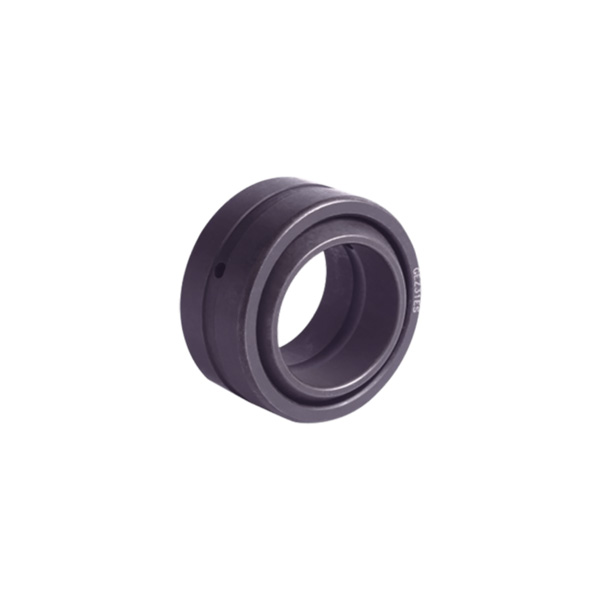
GE-UK changes the sliding system, rather than simply adding a service convenience to GE-ES. Dongzhou describes the UK range as PTFE-lined, with a chromium-plated spherical surface on the inner ring. Its steel-on-steel range instead lists phosphated bearing-steel rings. These descriptions identify different constructions; they are not comparative wear-life test results.

Change the maintenance plan only after reviewing the duty
Maintenance-free does not mean unlimited load, unlimited temperature or no inspection. Before choosing a UK design, establish the load direction and magnitude, movement, frequency, environment and available protection. Then review the exact product against those requirements. Do not transfer a grease type or replenishment schedule from an ES assembly to a PTFE-lined design without checking its instructions.
For a factory review, I separate two requests: preserving an existing steel-on-steel arrangement, and redesigning the arrangement to avoid routine greasing. The second request needs a sliding-system review, not merely a code substitution on the purchase order. Nor should another manufacturer's PTFE-related suffix be treated as proof of the same liner construction.
My selection rule: choose the maintenance arrangement the machine can support, then verify the bearing for that duty. Do not choose a suffix first and build the justification around it.
Dongzhou Spherical Plain Bearing Size Chart: Compare More Than the Bore
The following entries show why a dimensional match deserves further investigation, not automatic approval. All four dimension columns use millimetres. The values come from Dongzhou's steel-on-steel product table and GE-UK product table.
| Listed designation | Bore d | Outside D | Inner width B | Outer width C | Review point |
|---|---|---|---|---|---|
| GE6E | 6 | 14 | 6 | 4 | Steel / steel |
| GE6UK | 6 | 14 | 6 | 4 | Same four sizes; PTFE-lined contact |
| GE20ES / GE20ES-2RS | 20 | 35 | 16 | 12 | Identify the required seal variant |
| GE20UK | 20 | 35 | 16 | 12 | Same four sizes; different sliding system |
| GE30ES / GE30ES-2RS | 30 | 47 | 22 | 18 | Keep the full suffix on the order |
GE6E and GE6UK share the listed 6 / 14 / 6 / 4 mm dimensions. That does not make the steel-on-steel and PTFE-lined contacts identical. The same issue appears in the 20 mm entries, where sealing adds another decision.
GE20ES-2RS and GE20UK: a dimensional match needs a functional review
For a 20 mm bearing replacement, I compare GE20ES-2RS with GE20UK using the actual Dongzhou catalogue rows. The GE20ES-2RS entry lists a 20 mm bore, 35 mm outside diameter, 16 mm inner-ring width and 12 mm outer-ring width. The GE20UK entry lists the same four dimensions.
That establishes a match in the listed nominal dimensions, but it leaves a choice between different sliding systems. GE20ES-2RS belongs to the steel-on-steel range with the ES lubrication features and seals on both sides. GE20UK belongs to the PTFE-lined range. The UK designation alone does not establish an equivalent sealing arrangement.
I would take the review in two directions. If the replacement must preserve the existing steel-on-steel, sealed arrangement, I would assess the exact ES-2RS part against the drawing, available grease path and operating requirements. If the objective is to change the maintenance arrangement, I would assess the UK design separately, including its sliding-material limits and the environmental protection required by the machine.
My conclusion is specific: the catalogue shows a match in these four principal dimensions, which makes a comparison worthwhile. It does not establish unrestricted interchangeability. The replacement specification must still resolve the sliding pair, lubrication, sealing, clearance and operating conditions before approval.
Match symbols and units before comparing catalogues
Read each catalogue's diagram rather than carrying its letters across to another table. B may denote a bore in one system and an inner-ring width in another; W and T may appear as width symbols elsewhere. Here, the table follows Dongzhou's d / D / B / C definitions.
The symbol C also needs context. In the size columns above it means outer-ring width, in mm. In a load-rating column, C may mean dynamic load rating. Never compare numbers until the quantity, unit and rating conditions are explicit. Metric dimensions do not prove that every load column in a catalogue uses the same unit system.
Can GE Spherical Plain Bearings Be Interchanged?
A cross-reference can identify a candidate bearing. Approval needs three checks: whether it fits, whether it preserves the required functions, and whether it suits the actual duty. A match in the four dimensions above answers only part of the first check.
| Check | What to compare | What a match does not prove |
|---|---|---|
| Dimensional | d, D, B, C, chamfers, shoulders and housing space | Equal sliding materials or maintenance requirements |
| Functional | Sliding pair, lubricant supply, seals, clearance and tolerances | Suitability for the machine's full load and movement |
| Application | Load direction, movement, frequency, environment, support and inspection requirements | Approval without the agreed verification evidence |
What the standards establish
ISO 12240-1:1998 addresses dimension series, tolerances and radial internal clearances for radial spherical plain bearings. Its scope allows different sliding-material combinations within the dimensional system. A common dimensional reference therefore does not establish a common liner or lubrication regime.
Load rating is a separate matter. ISO 20015:2017 concerns static and dynamic load-rating calculation methods for spherical plain bearings in the stated ISO 12240-1, -2 and -3 size ranges; it excludes rod ends covered by ISO 12240-4. Neither standard's scope turns a designation match into a product test result. For the next level of selection, use the load-rating and life guide with the exact bearing's confirmed data.
How to review a GE bearing replacement
Use this sequence to prepare a replacement decision from an existing bearing specification, its assembly drawing and the proposed bearing data. Complete the review before approving the candidate for the machine.
-
Identify the original bearing completely
Record the manufacturer, complete designation, drawing revision and any additional markings. Retain the existing specification rather than relying on a shortened purchase description.
-
Compare the full geometry
Check d, D, B and C against each drawing's definitions and units. Add chamfers, abutments and the shaft and housing interfaces; a bore and outside-diameter match is not enough.
-
Resolve sliding contact and lubrication
Identify steel-on-steel or PTFE-lined contact. For a lubricated arrangement, trace the supply route to the bearing. For a material-system change, obtain the candidate's operating and maintenance requirements.
-
Check seals, movement and environment together
Confirm the required seal arrangement and available movement in the assembly. Review contamination, temperature and other exposure against the exact product, not the suffix alone.
-
Review fits, tolerances and clearance
Compare the specified fits and internal clearance, then define the required installed condition. Include the shaft, housing and shoulders in this review rather than treating the bearing as an isolated part.
-
Match the ratings to the duty
Confirm load units, rating definitions and applicable conditions. Compare them with the machine's load direction, movement and frequency. Do not rank candidates from an unexplained catalogue number.
-
Set acceptance requirements before approval
Agree who approves the substitution and what evidence is required: dimensional inspection, material and seal identification, assembly checks and any application testing needed for the duty. Record the approved complete code.
Installation can change the final condition of the bearing. Follow the drawing-specific requirements and use the fits and installation guide when preparing the assembly checks.
What to Send Dongzhou for a GE Bearing Review
A useful inquiry explains what must remain unchanged and why a replacement is being considered. “Same size, maintenance-free” does not tell us whether the machine needs the existing seals, whether a grease passage is available or which operating condition prompted the change.
- Original identity: full code, manufacturer, marking photographs and the current drawing or sample.
- Assembly geometry: d, D, both ring widths, shaft and housing details, shoulders, fits and available movement.
- Contact and maintenance: existing sliding system, grease route and access, or the requirement to avoid routine greasing.
- Duty and environment: load direction and magnitude, movement, frequency, temperature, contamination and sealing needs.
- Approval target: features that must be preserved, the reason for the change and the required inspection or application checks.
When I review that information, the first decision is whether the request is a like-for-like replacement or a change of bearing system. That distinction keeps a maintenance redesign from slipping through as a routine dimensional substitution. You can compare the available Dongzhou radial spherical plain bearing ranges before submitting the full requirements.
Questions About GE Bearing Codes
Does the number in GE20ES mean a 20 mm bore?
For Dongzhou's listed GE20ES and GE20ES-2RS, yes: d is 20 mm. Use the complete manufacturer's entry to confirm this; do not apply a rolling-bearing bore-code multiplier.
Does 2RS mean the bearing needs no grease?
No. In the listed Dongzhou design, 2RS identifies seals on both sides. It does not change the steel-on-steel sliding contact or establish a maintenance-free lubrication arrangement.
Does an E-type bearing without lubrication holes need no lubrication?
No. The absence of a dedicated passage does not establish a self-lubricating liner. Confirm the lubrication requirements for the exact E design and its assembly rather than inferring them from the missing holes.
Can GE20UK directly replace GE20ES-2RS?
Not on dimensions alone. Dongzhou lists the same 20 mm bore, 35 mm outside diameter, 16 mm inner-ring width and 12 mm outer-ring width, but the sliding system differs. Sealing, lubrication, clearance and operating requirements still need review.
Are GE-C, GE-UK and other PTFE-lined codes universally interchangeable?
No. Read each manufacturer's designation and exact product data. A PTFE-related description does not establish identical liner construction, seals, tolerances, ratings or application limits across brands.
What should I measure if the original marking is unreadable?
Record the bore, outside diameter and both ring widths, together with photographs, visible seal and lubrication features, and the shaft and housing arrangement. Do not assign a nominal replacement from worn measurements alone; compare the findings with the original drawing or obtain a technical review.